What Happens After Your Crowdfunding Campaign Ends: A Complete Guide
Jun 15, 2026

The campaign timer hits zero. The final pledge total is locked in. The feeling in that moment is something between relief and euphoria, and for most first-time crowdfunding creators, it is followed almost immediately by a question they did not spend nearly enough time thinking about before they launched.
Now what?
The crowdfunding world is full of resources on how to launch a campaign. How to build your audience, write your page, run your ads, and handle your first 48 hours. The period after the campaign ends gets far less attention, and that gap shows up in the outcomes.
Campaigns that fund and then go quiet, miss their delivery timelines, manage their backers poorly, or fail to translate their crowdfunding success into a real business are far more common than the success stories suggest. The difference between a campaign that becomes a company and one that becomes a cautionary tale is almost entirely in what happens after the campaign closes.
This is a complete guide to that period.
The First 48 Hours After Your Campaign Closes
The campaign is over, but your backers are paying attention more closely than at almost any other point in the process.
They just gave you money. They want to know that someone is minding the store, that the product they backed is real, and that the creator they trusted is taking the responsibility seriously.
Send a campaign closing update within 24 hours of the campaign ending. Not a generic thank you. A personal, substantive message that tells your backers exactly what has been raised, what that means for production, what the timeline looks like, and what they can expect in terms of communication going forward.
This update sets the tone for everything that follows. Backers who receive a thoughtful, detailed closing message from a creator who is clearly organized and on top of things feel very differently about the wait ahead of them than backers who hear nothing for a week after the campaign ends.
Be specific in this message. Tell them the exact funding total. Tell them how many backers you have. Tell them when you expect to place your manufacturing order. Tell them what the next communication they receive from you will be about and roughly when it will arrive. Specificity signals competence. Vagueness signals the opposite.
Collecting Backer Information
If you ran your campaign on Kickstarter, you will need to send a backer survey to collect shipping addresses, reward tier selections for any options you offered, and any other information you need to fulfill orders.

Kickstarter has a built-in survey tool called BackerKit integration or its own pledge manager. Indiegogo has similar functionality. Send your backer survey as soon as the platform allows after the campaign closes.
Keep the survey short and clear. Every additional field you add is another point where a backer might abandon the form and come back to it later, or not come back at all. Collect what you actually need. Do not collect what would merely be nice to have.
Follow up with backers who do not complete the survey. Survey completion rates are rarely 100 percent on the first send. A polite reminder email two weeks after the initial send typically recovers a meaningful portion of non-respondents. Keep following up at reasonable intervals until you have what you need, because a backer who never submits their shipping address is a backer you cannot fulfill.
Set a clear deadline for survey completion and communicate it. Backers who know they have until a specific date to respond are more likely to act than those facing an open-ended request.
Moving Your Backers to Your Own Platform
This is a step that many first-time creators overlook and later regret.
Your Kickstarter or Indiegogo backers are on the platform's list, not yours. When the campaign ends, your direct access to them depends on the tools the platform provides, which are functional but limited. Building a real relationship with your backers requires moving them onto a communication channel you own and control.
The most valuable thing you can do in the immediate post-campaign period is get every backer onto your own email list. Include an invitation in your closing update and in your backer survey. Create a dedicated email list segment for campaign backers. From this point forward, your backer updates go to both the platform and your own email list.
This is not just about having a backup channel. It is about building the kind of direct relationship with your early customers that turns them into long-term brand advocates. Backers who feel a genuine connection with you as a creator and with the brand you are building are the ones who buy your next product, who refer their friends, and who defend you publicly when something inevitably goes wrong.
The Kickstarter backer relationship ends when the campaign ends. The email list relationship is yours to develop indefinitely.
Manufacturing: What Happens Next and How Long It Actually Takes
For most physical product campaigns, manufacturing is where the timeline between campaign close and delivery is made or broken.
If you did your pre-campaign preparation properly, you already have manufacturer relationships established, quotes in hand, and a clear understanding of your production timeline. If you did not, this phase is going to be more painful and more expensive than it needed to be.
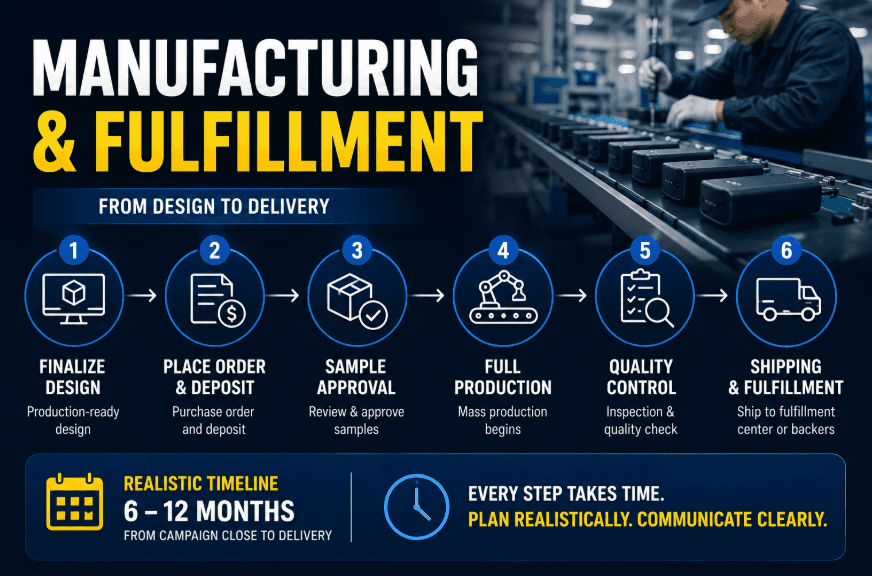
The manufacturing process for a crowdfunding campaign typically involves finalizing your production-ready design, which may require changes from your prototype based on manufacturability or cost considerations, placing your purchase order and paying the required deposit, going through sample approval where the manufacturer produces a small run for your review before full production begins, full production, quality control inspection, and shipping the finished units to your fulfillment center or directly to backers.
Each of those steps takes longer than the optimistic timeline suggests. Sample approval alone can take two to three rounds if the first sample has issues that need to be addressed. Quality control inspections at the factory catch problems before they ship, but add time. Inbound freight from overseas manufacturers to your fulfillment location takes weeks by sea.
A realistic manufacturing and fulfillment timeline for most first campaigns is six to twelve months from campaign close to delivery. Some products take less. Some take more. The important thing is to have an honest assessment of what your specific product requires and to communicate that timeline to backers clearly from the beginning.
Communication During the Wait: How to Keep Backers on Your Side
The period between campaign close and product delivery is where backer relationships are made or destroyed.
Backers who receive regular, honest updates throughout the production process remain patient through delays, trust the creator through setbacks, and arrive at delivery excited rather than exhausted. Backers who hear nothing for months and then receive a delay notice with no explanation become the angry voices in crowdfunding horror story comment sections.
Send a meaningful backer update at a minimum once a month throughout the production period, more frequently when there is something specific to share. Less frequently than once a month, and you start losing backers' trust, regardless of how good your reasons are.
What goes in these updates? Real information. Manufacturing milestones that have been hit. Photos from the factory floor. Decisions that were made and why. Problems that came up and how they were solved. A clear view of where things stand and what comes next.
The level of transparency that works best with crowdfunding backers is higher than most creators initially feel comfortable with. Sharing factory photos that show the product at an intermediate stage of production, or admitting that a component sourcing issue pushed the timeline back by three weeks, feels like exposing vulnerability. To backers, it feels like being treated as a partner rather than a customer. That distinction matters enormously for how they respond to the inevitable moments when things do not go exactly as planned.
Handling Delays Honestly
Delays happen. Almost every first-time crowdfunding campaign ships later than the original timeline promised. This is so common that experienced backers largely expect it.
What separates the campaigns that recover from delays gracefully from the ones that turn delays into crises is almost entirely how the delay is communicated.
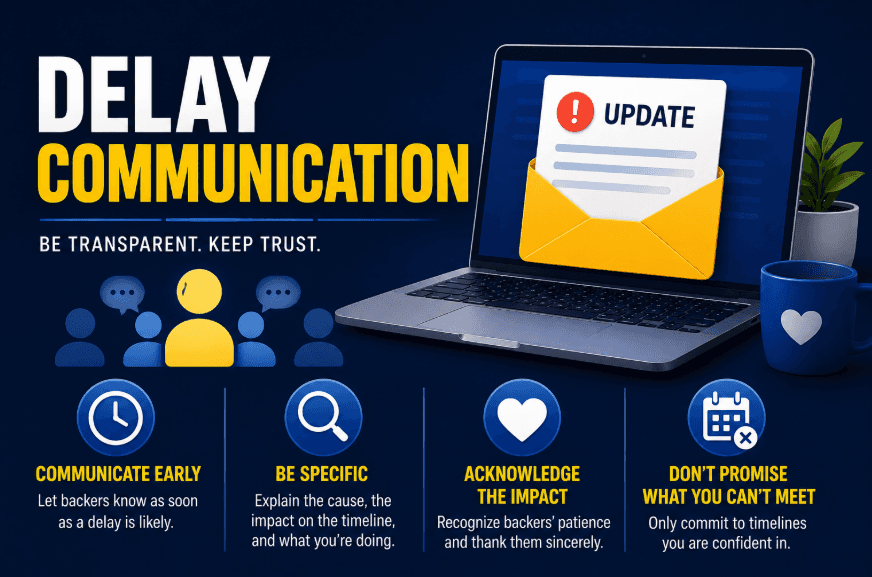
Communicate early. The moment you know a delay is likely, tell your backers. Do not wait until the original deadline has passed and backers are already asking questions. Do not hope that things will speed up and the delay will become irrelevant. Get ahead of it.
Be specific. Tell backers what caused the delay, how long it is expected to add to the timeline, and what you are doing about it. A vague message saying things are taking longer than expected and you will update everyone soon is worse than saying nothing. A specific message explaining that a component supplier missed their delivery date, that you have sourced an alternative supplier, and that the production timeline is now shifted by six weeks gives backers something concrete to hold onto.
Acknowledge the impact. Backers who have been waiting for months for a product they paid for in good faith deserve to have that acknowledged directly. A sentence that recognizes their patience and thanks them genuinely for it costs nothing and matters more than most creators expect.
Do not promise a new timeline you are not confident in. One delay is something backers can accept. A pattern of promised timelines that turn out to be wrong destroys trust in a way that is very difficult to rebuild.
Dealing With Refund Requests
Some backers will ask for refunds during the production period, particularly if delays extend significantly beyond the original timeline.
Your legal obligation regarding refunds depends on where you are based, where your backers are located, and the terms you agreed to when you launched on the platform. Read your platform's policies carefully.
Beyond the legal question, there is a practical and relational one. How you handle refund requests shapes how that backer talks about you publicly. A backer who asked for a refund and was treated with respect and fairness is far less likely to leave a damaging public comment than one who felt stonewalled or dismissed.
For backers who request refunds due to significant delays, a reasonable approach is to honor the request when you can afford to do so. If your margins are tight and honoring every refund request would put your ability to fulfill the remaining orders at risk, be honest about that and offer a credit toward a future purchase or an alternative resolution.
Whatever your policy is, be consistent and be kind. The crowdfunding community is smaller and more connected than it looks. How you treat your backers in difficult moments gets talked about.
Fulfillment: Getting the Product to Every Backer
Fulfillment is the most operationally complex part of the post-campaign period and the one that catches the most first-time creators by surprise.
If you are shipping to backers in multiple countries, which most campaigns do, you are dealing with different customs requirements, different shipping rates, different carrier options, and different backer expectations in different markets. Managing this yourself while also running a business is genuinely difficult.
Most campaigns that reach a certain scale use a third-party fulfillment center to handle the physical storage, picking, packing, and shipping of orders. Services like ShipBob, Whiplash, or regional fulfillment partners in major markets can handle the operational complexity while you focus on the rest of the business.
If you are using a fulfillment center, your inbound freight timeline, the time it takes to get your finished goods from the manufacturer to the fulfillment center, needs to be factored into your overall delivery timeline. This leg of the journey often takes longer than expected and is where last-mile delivery calculations go wrong.
For international backers specifically, be clear in your communications about the customs and import duty situation in their country. Some countries charge significant import duties on physical goods that backers may not have anticipated when they pledged. Being transparent about this before it happens prevents a lot of frustration at delivery.
When Things Go Wrong During Fulfillment
Fulfillment problems are not a sign that you failed. They are a normal part of shipping physical products to hundreds or thousands of people in multiple countries simultaneously.
Packages get lost. Customs holds things up. Quality issues that slipped through the factory inspection surface when products are in backers' hands. The address data collected in surveys turns out to have errors.
Have a clear process for handling each of these before they happen. What is your policy for lost packages? How do you handle a quality issue that affects a significant number of units? Who is the point of contact for backer fulfillment issues, and what is the response time commitment?
When problems surface publicly in your campaign comments or on social media, address them publicly as well as privately. A public acknowledgment that an issue exists and a clear statement of how it is being resolved reassures the backers who have not yet experienced the problem and demonstrates to everyone watching that you take your obligations seriously.
After Delivery: Turning Backers Into Long-Term Customers
Delivery is not the end of the relationship. For the creators who build lasting businesses from their crowdfunding campaigns, delivery is the beginning of a customer relationship that has real long-term value.
Send a delivery confirmation email that thanks backers for their patience and support, invites them to share their experience, and gives them a clear path to reach you if they have any questions or issues with their order. Include a genuine ask for a review or testimonial if they are happy with the product.
Keep your email list active after the campaign ends. Share updates on what is coming next. Give your campaign backers early access or exclusive pricing on future products. Treat them as the founding community of your brand rather than as one-time customers whose transaction is complete.
The backers who loved your first product and felt well-treated throughout the journey from campaign to delivery are your best possible early adopters for your next launch. They already trust you. They are already advocates. They already know how crowdfunding works, and they are willing to go through it again with a creator who earned their trust the first time.
Building Toward What Comes Next
A successful crowdfunding campaign is a powerful proof of concept. It demonstrates real consumer demand, real ability to execute, and real community support. Used properly, it is also the foundation for what comes next.
Some creators use their campaign success to approach retail buyers who want to see market validation before stocking a product. A Kickstarter campaign that raised $50,000 is a compelling data point in that conversation.
Others use it to approach investors who are more willing to fund a product that has already demonstrated demand than one that has only ever existed as a pitch deck.
Others use it to move directly into e-commerce, using the audience and community built during the campaign as the foundation for a direct-to-consumer brand.
All of these paths are real, and all of them are made easier by a well-run campaign that delivered on its promises and built genuine trust with its backers.
The campaign is the beginning. What you build with it is entirely up to you.
If you want help thinking through your post-campaign strategy or are planning your next launch and want to set it up properly from the start, SVBY has helped campaigns raise over $50,000 on Kickstarter and build real businesses from their crowdfunding success. Book a free 30-minute call and let's talk about where you want to go next.