Crowdfunding vs Angel Investment: Which One Is Right for Your Product
May 28, 2026

At some point in the life of almost every physical product, the founder sits down and has a version of the same conversation with themselves.
The product is real. The demand feels real. But turning a prototype into something that ships to customers at scale requires money that is not sitting in a personal bank account. So where does it come from?
Two paths come up more than any other for early-stage hardware and physical product founders. Crowdfunding and angel investment. Both can work. Both have produced companies worth talking about. And both are completely wrong for certain founders in certain situations, regardless of how attractive they look from the outside.
The choice between them is not about which one is better in the abstract. It is about which one fits your product, your timeline, your goals, and the stage you are actually at right now.
Here is an honest comparison.
What You Are Actually Giving Up With Each Option
Before anything else, understand the fundamental difference in what each path costs you.
Crowdfunding costs you time, effort, and money to execute. A well-run campaign requires months of preparation, real marketing spend, and a significant amount of the founder's attention throughout the campaign period. But when it is over, you own exactly the same percentage of your company that you owned before it started. Every dollar raised belongs to the business and to you. No one gets a seat at your table. No one gets a say in your decisions.

Angel investment costs you equity. An angel investor gives you money in exchange for an ownership stake in your company. How much equity depends on the valuation you agree on and the amount they invest. But from the moment that deal closes, that percentage of your company belongs to someone else permanently. They have a financial interest in every decision you make from that point forward, and depending on the terms of the deal, they may have more formal influence than that.
Neither of those costs is inherently bad. They are just different. And understanding which cost you are more willing to pay tells you a lot about which path makes more sense for you.
When Crowdfunding Is the Right Choice
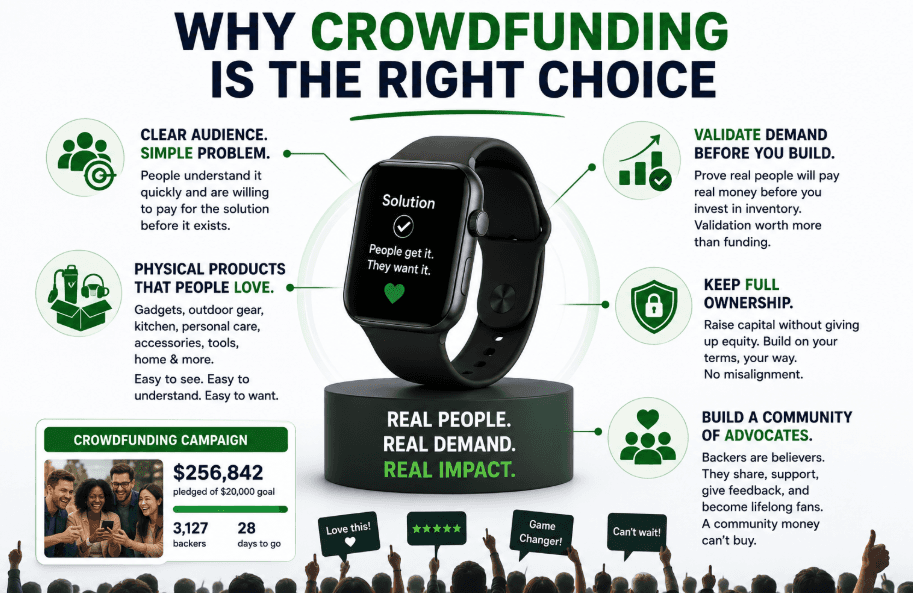
Crowdfunding works best when your product has a clear and identifiable consumer audience, when the problem it solves is something people can understand quickly, and when there is enough emotional or practical appeal in the product to make someone who has never heard of you willing to pay for it before it exists.
Physical consumer products are where crowdfunding has the most consistent track record. Gadgets, outdoor gear, kitchen products, personal care, accessories, bags, tools, and home products. Things that people can see, understand, and want. Things that photograph well and demonstrate clearly in a two-minute video.
Crowdfunding is also the right choice when you want to validate demand before committing to a full production run. One of the most underappreciated things about a successful crowdfunding campaign is that it proves real people will pay real money for your product before you have spent your entire budget on inventory that might not sell. That validation has value beyond the money raised.
It is the right choice when you want to keep full ownership of your company. If you are building something you intend to grow slowly, profitably, and on your own terms, giving away equity at an early stage can create misalignment with an investor who has a different timeline or exit expectation than you do.
It is also the right choice when you want your first customers to be genuine advocates. Crowdfunding backers are not just buyers. The best ones are early believers who share the campaign, leave reviews, give feedback, and become the kind of vocal fans that money genuinely cannot buy. That community has real long-term value for a brand that is just getting started.
When Crowdfunding Is the Wrong Choice
Not every product is a good fit for crowdfunding, and forcing a product onto a platform it does not suit is one of the more expensive mistakes a founder can make.
B2B products are difficult to crowdfund. If your product is sold to businesses rather than consumers, the Kickstarter and Indiegogo audiences are not your buyers. The campaigns that work on those platforms are largely consumer-facing. A business software tool, an enterprise hardware system, or a specialized professional instrument is going to struggle to find its customer base through crowdfunding, regardless of how good the product is.
Deep technology products with long development timelines are also a poor fit. If your product requires two more years of R and D before it can be manufactured and shipped, promising backers delivery in twelve months is not realistic. Crowdfunding works on a timeline that most deep tech products cannot honestly match, and backers who wait years for a product they paid for upfront tend to become vocal critics rather than advocates.
Products with very high price points face a different challenge. When the average reward tier needs to be several thousand dollars for the economics to work, the pool of people willing to pay that much on a crowdfunding platform for something that does not exist yet shrinks dramatically. High-ticket items can be funded through crowdfunding, but the conversion rate challenges are significant.
And if you need more money than crowdfunding can realistically deliver for your category and audience, crowdfunding is the wrong primary source of capital. It can be a useful complement to other funding, but treating it as the solution to a capital requirement that it cannot meet is a path to a funded campaign that still cannot deliver.
When Angel Investment Is the Right Choice
Angel investment makes the most sense when you need more capital than a crowdfunding campaign can reliably raise, when your product has a longer development timeline before it is ready for market, or when the strategic value of having the right investor involved outweighs the cost of the equity you are giving up.
The right angel investor brings more than money. They bring connections, experience, and credibility that can open doors a founder cannot open alone. An angel who has built and sold companies in your category, who knows your potential customers, and who has relationships with the manufacturers or distributors you need access to, is worth a meaningful equity stake if that access actually accelerates the business.
Angel investment is also the right choice when your product requires significant capital before it can demonstrate traction. Some products need to reach a certain threshold of development, testing, or regulatory approval before they can be shown to the public at all. Crowdfunding requires a product that is far enough along to be photographed, filmed, and publicly presented. If yours is not there yet, angel capital can fund the development work that gets you to the point where crowdfunding becomes viable.
And if your goal is to build a venture-scale company with an eventual acquisition or IPO as the exit, angel investment is more aligned with that path. Investors expect that kind of outcome. Crowdfunding backers expect a product.
When Angel Investment Is the Wrong Choice
Angel investment is not inherently more sophisticated or more serious than crowdfunding. It is just a different tool. And like any tool, it is wrong for certain situations regardless of how prestigious it sounds.
If you are not ready to give up equity, do not take angel investment. This seems obvious, but founders regularly take angel money before they are genuinely ready for what that means, because the validation feels good and the capital feels necessary. Giving up equity is a permanent decision. Make sure you have thought clearly about what it means for your ownership, your decision-making autonomy, and your long-term relationship with the business before you accept it.
If you do not have traction or evidence of demand yet, raising angel investment is harder than most first-time founders expect. Angels invest in people and in evidence. A prototype and a vision are sometimes enough if the founder's track record is strong. But a first-time founder with a prototype and no customers, no waiting list, no pre-orders, and no demonstrated demand is going to find most angels skeptical, regardless of how good the product is.
A successful crowdfunding campaign is one of the most compelling pieces of evidence you can bring to an angel investor. It demonstrates that real people will pay real money for your product, that you can execute a complex launch, and that there is a community behind what you are building. Many founders use crowdfunding as the validation that makes their subsequent angel round possible.
If your product is ready for that sequence, it is worth considering seriously.
The Equity Question Deserves More Thought Than It Usually Gets
Founders who are new to raising outside capital often underestimate how permanent equity decisions are.
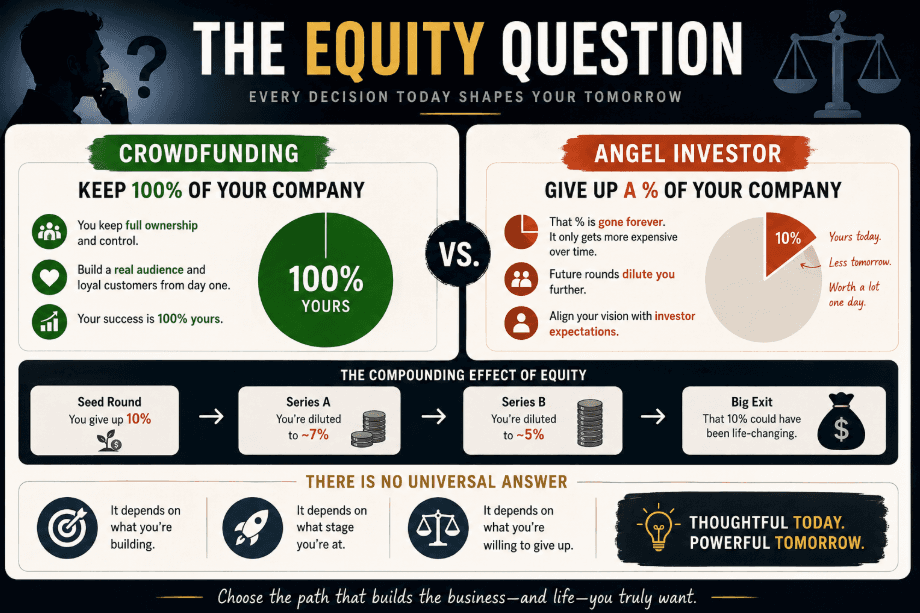
When you give an angel investor ten percent of your company at a seed valuation, that ten percent does not come back. If the company grows significantly, that ten percent becomes worth a lot of money that belongs to someone else. If you raise additional rounds of funding, your stake gets diluted further. The decisions you make about equity in the earliest stages of a company compound in ways that are easy to underestimate when the numbers feel abstract.
This does not mean angel investment is a bad decision. It means it deserves genuine careful thought rather than being treated as the obvious sophisticated choice compared to crowdfunding.
Some founders who could have raised angel capital have built better businesses by crowdfunding instead, because they retained full ownership, were forced to build a real consumer audience from day one, and never had to align their vision with an investor's expectations.
Others have built businesses that would not exist without the capital and connections that angel investment provided.
The right answer is not universal. It depends on what you are building, what stage you are at, and what you are willing to give up.
The Hybrid Path That More Founders Should Consider
Crowdfunding and angel investment are not mutually exclusive. Many successful founders have used both, in a sequence that makes each one more powerful.
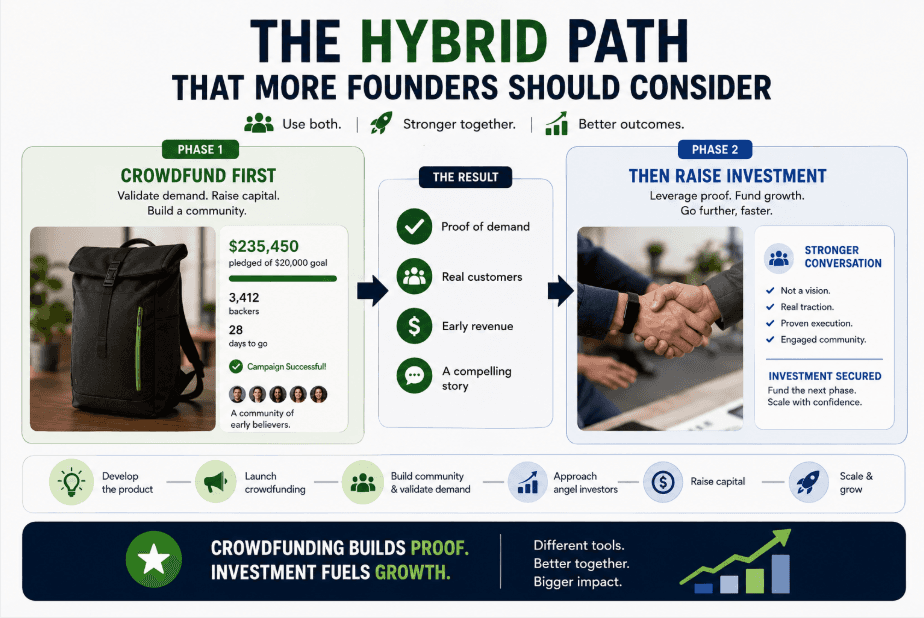
The most common version of this goes like this. A founder develops a product to the point where it can be credibly presented to the public. They run a crowdfunding campaign to validate demand, raise initial capital, and build a community of early customers. The campaign succeeds. Now they have proof of concept, a customer base, revenue, and a compelling story.
They take that story to angel investors. The conversation is completely different from the one they would have had before the campaign. They are no longer asking an investor to believe in a vision. They are showing an investor a product that real people have already paid for, a campaign that demonstrated their ability to execute, and a community that is already engaged.
The angel investment that follows funds the next phase of development, a larger production run, or an expansion into distribution channels that crowdfunding alone cannot reach.
This sequence works well for physical consumer products that have a clear crowdfunding audience and longer-term ambitions that require more capital than crowdfunding alone can provide. It is not the only path, but it is one that more founders should consider before choosing between crowdfunding and investment as if they are mutually exclusive.
Questions Worth Asking Before You Decide
Rather than a checklist, here are a few questions worth sitting with honestly before you commit to either path.
How much capital do you actually need, and can crowdfunding realistically deliver it for your product and category? Be honest about this number and realistic about what campaigns in your space actually raise, not what the outliers raised.
Are you ready to give up equity, and do you understand what that means for your ownership and decision-making over the long term?
Does your product have a consumer audience that can be reached through crowdfunding platforms, or is your buyer a business or a highly specialized professional?
Is your product far enough along to be publicly presented in a way that would make a stranger willing to pay for it before it exists?
Do you have a track record or evidence of demand that would make an angel investor confident in you before you have customers?
What does the investor bring beyond capital, and is that worth the equity?
Is your timeline compatible with crowdfunding, which moves fast, or does your product need more development time before it is ready for public commitment?
The answers to those questions will point more clearly toward the right path than any general framework can.
The Choice Is About Fit, Not Prestige
There is a tendency in some founder circles to treat angel investment as the more serious or legitimate option and crowdfunding as something you do when you cannot raise real money. That framing is wrong, and it leads founders to make choices that are not in the interest of their business.
Crowdfunding has produced real companies with real customers and real revenue that went on to raise significant institutional capital, get acquired, and build lasting brands. It is not a consolation prize. For the right product at the right stage, it is the best possible starting point.
Angel investment has funded companies that changed industries. It has also funded companies that spent years trying to satisfy investor expectations that were never aligned with what the founder actually wanted to build.
Neither path is inherently better. The right one is the one that fits your product, your stage, your goals, and your willingness to pay the costs that each one requires.
Figure out which path is before you commit to either. The decision is more important than most founders treat it.
If you are trying to figure out whether crowdfunding is the right move for your product and what it would actually take to run a campaign that succeeds, SVBY has helped founders work through exactly this question. Book a free 30-minute call, and let's talk through what makes sense for what you are building.