The Biggest Mistakes First-Time Kickstarter Creators Make Before They Launch
Jun 4, 2026

The most expensive mistakes in crowdfunding do not happen during the campaign. They happen in the months before it.
By the time a campaign goes live, most of the critical decisions have already been made. The audience is either built or it is not. The page either converts or it does not. The product is either campaign-ready or it is not. The financial model either makes sense or it does not. Fixing these things after launch is possible, but it is slow, expensive, and often not enough to change the outcome.
The creators who launch strong are almost never the ones who figured everything out faster than everyone else. They are the ones who avoid the mistakes that quietly sink campaigns before the first backer ever shows up.
Here are the ones that come up most consistently.
They Treat Validation as Optional
The excitement of a new product idea is one of the most reliable sources of bad decision-making in crowdfunding.
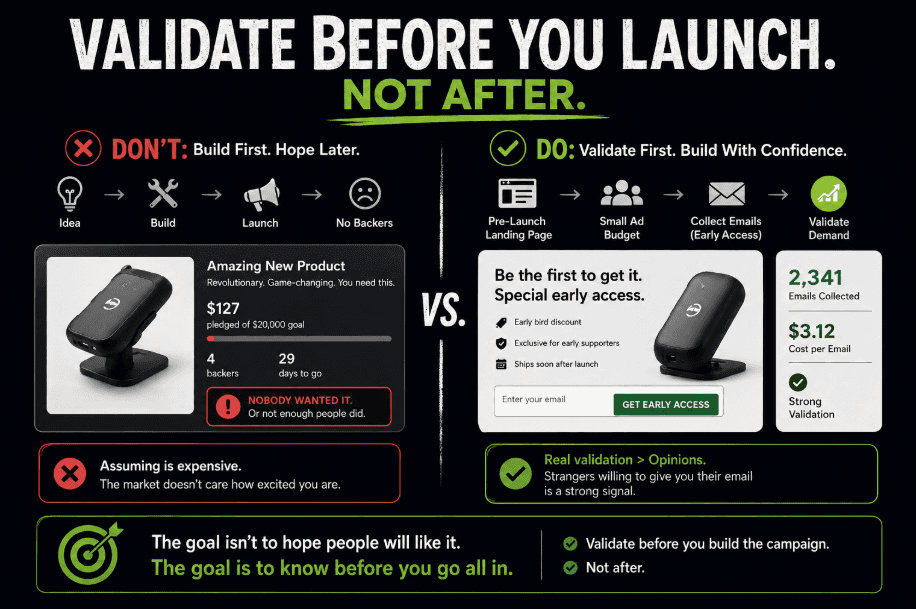
A creator has an idea. The idea feels right. Friends and family agree it is great. The creator spends months building a prototype, designing a campaign page, and preparing for launch. Then the campaign goes live, and the market delivers a verdict that friends and family never did.
Nobody wanted it. Or at least, not enough people wanted it at the price point required to make the economics work.
This outcome is completely preventable, and it happens constantly because creators treat validation as something that happens during the campaign rather than before it.
Real validation means finding out whether strangers will pay for your product before you have invested everything in launching it. Not whether they think it is a good idea. Not whether they would buy it if it were cheaper. Whether they will actually commit real money to something that does not exist yet, from a creator they have never heard of, on a platform that requires them to trust a promise.
The simplest form of validation is a pre-launch landing page with a small ad budget behind it. If you cannot convince cold traffic to give you their email address in exchange for early access at a discount, that is important information. The email address is a much lower commitment than a pledge. If people will not give you that, the campaign has a serious problem that more preparation will not fix.
Validate before you build the campaign. Not after.
They Start Building Their Audience Too Late
Ask most first-time crowdfunding creators when they started building their pre-launch email list, and the answer is usually somewhere between two weeks and two months before launch.
That is too late for almost every campaign.
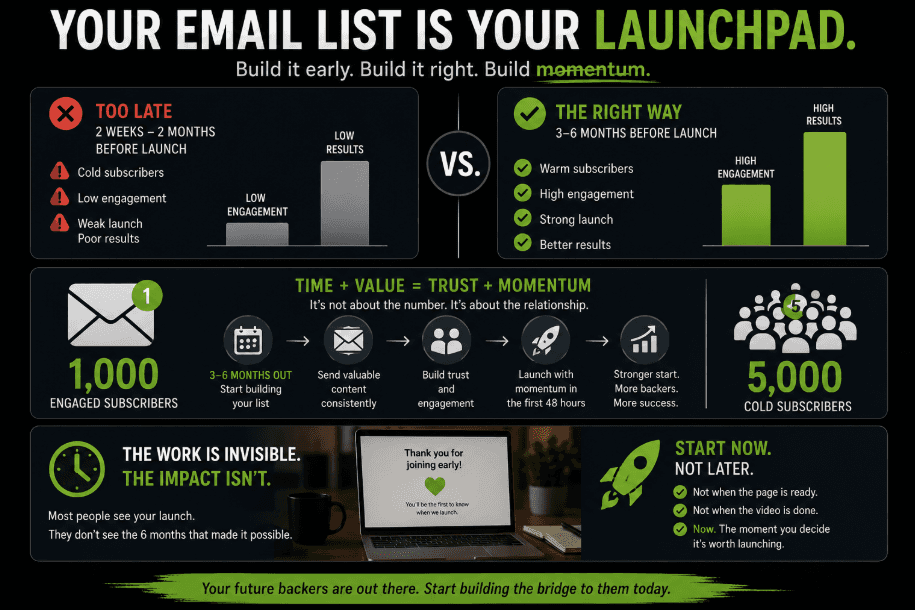
The email list is the single most important asset a crowdfunding campaign has on launch day. It is the difference between the first 48 hours that creates momentum and one that creates silence. Building a list that is large enough and warm enough to deliver that momentum takes time that most creators underestimate.
A list of 1,000 engaged subscribers who have been hearing from you regularly for three months will outperform a list of 5,000 people who signed up two weeks ago and have received one email. Engagement and warmth matter more than raw numbers, and both take time to build.
The creators who look at a $100,000 campaign and wonder how they got there rarely hear about the six months of pre-launch list building that made the first 48 hours possible. That work is invisible by launch day. But it is what everything else sits on.
Start building the list the moment you decide the product is worth launching. Not when the campaign page is ready. Not when the video is done. Now.
They Underestimate How Long Everything Takes
There is a version of the crowdfunding preparation timeline that exists in a creator's head and a version that exists in reality. They are rarely the same.
In the head version, the prototype is ready in six weeks. The campaign video gets produced in a weekend. The landing page goes up in the afternoon. Launch happens in three months.
In reality, the prototype takes four months and two redesigns. The production company has a three-week lead time, and the first cut of the video needs significant revision. The landing page goes up, but the ads take two weeks to optimize to a reasonable cost per lead. The campaign page copy needs three rounds of feedback before it is right. Kickstarter's review process takes longer than expected.
Every single phase of a crowdfunding preparation timeline takes longer in reality than in the plan. This is not a personal failure. It is the nature of building something real and doing it properly.
The creators who launch well-prepared are the ones who built buffer time into every phase from the beginning. They assumed the prototype would take longer and were right. They gave themselves more time for creative production than seemed necessary and used most of it. They started earlier than they felt urgent because they knew what rushed preparation looks like in a live campaign.
If you think you need three months to prepare, plan for five. If you think you need five, plan for seven. The cost of over-preparing is minimal. The cost of under-preparing shows up in your final pledge total.
They Set Their Goal Based on What Sounds Achievable
This one is quietly responsible for a lot of campaigns that technically succeed and practically fail.
A creator looks at their email list, their social following, and their gut feeling about the campaign, picks a number that feels achievable, and sets that as the goal. The campaign hits the goal. The creator celebrates. And then the financial reality of production and fulfillment arrives, and the celebration ends.
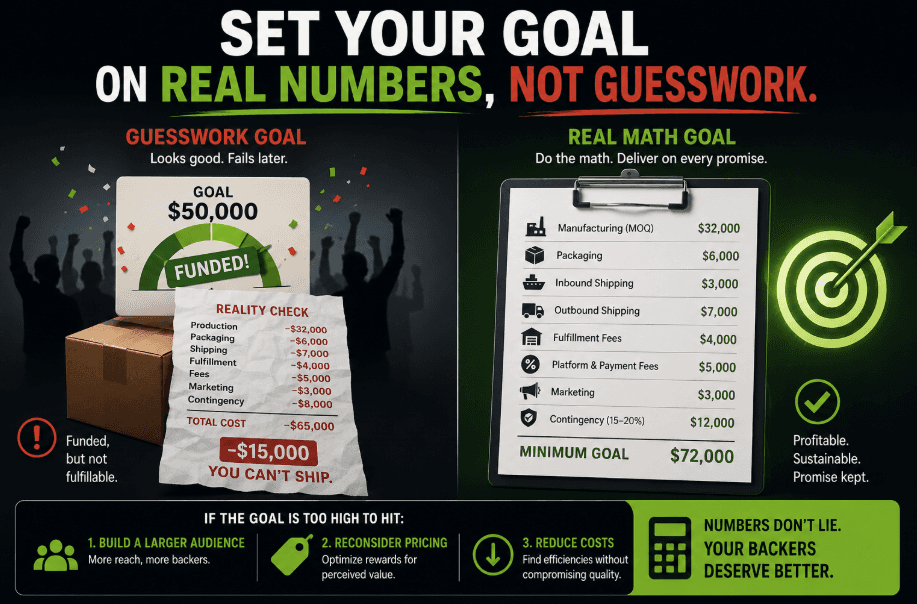
The goal was set based on confidence about what could be raised. It was never calculated based on what actually needs to be raised to deliver on every promise to every backer after every fee, cost, and contingency is accounted for.
The result is a funded campaign that cannot afford to ship.
Setting a crowdfunding goal is not about picking an impressive number or a conservative number. It is about doing real math. Manufacturing costs at the minimum order quantity. Packaging. Inbound and outbound shipping. Fulfillment fees. Platform and payment processing fees. Marketing costs are being recovered from campaign funds. A contingency buffer of 15 to 20 percent for the things that will inevitably cost more than expected.
Add all of that up, honestly. That number is your minimum goal. Not a number lower than that because it seems more achievable. That number.
If the honest cost calculation produces a goal that feels too high to hit with the audience you have built, the answer is either to build a larger audience before launching, to reconsider the pricing of your reward tiers, or to reduce your costs. The answer is not to set a lower goal and hope the math works out after the campaign ends.
They Build the Page for Themselves, Not for the Backer
Creators know their product deeply. They know the engineering decisions, the material choices, the iterations that did not work, the breakthrough that finally did. They care about these things intensely.
The backer does not care about any of them. At least not yet.
A campaign page built by a creator who has not made this distinction leads with what the creator finds interesting rather than what the backer needs to feel in order to back. It opens with the product instead of the problem. It lists features instead of benefits. It uses technical language that means something to the creator and nothing to a visitor who showed up from an ad thirty seconds ago.
The backer arrives at a campaign page with one implicit question. Is this worth my money and my trust? Everything on the page should be in service of answering that question for a specific person in a specific situation.
What is the problem this person has? Have you made them feel understood before you offered the solution? Is the product clearly explained in terms of what it does for them rather than what it technically contains? Is the social proof present and credible? Is the reward tier obvious and easy to act on?
A page that answers those questions effectively converts. A page that showcases the product the way the creator wants it showcased does not.
Read your page as the most skeptical possible version of your target backer before you publish it. Better yet, find real people who match that profile and watch them read it without any guidance from you. The places they get confused or lose interest are exactly where the page needs work.
They Ignore the Video Until It Is Too Late
Video production is the thing most first-time creators leave until last and underinvest in most consistently.
The video is the most important conversion asset on a campaign page. It is the first thing most visitors engage with. A video that does not hold attention, does not build desire, or does not end with a clear call to action actively hurts conversion rather than helping it.
Getting a crowdfunding video right takes more time than most creators plan for. A good production company needs to be booked weeks in advance. The script needs to be written and reviewed before shooting begins. The first cut almost always needs revision. Getting from brief to finished video typically takes three to five weeks, even when everything goes smoothly.
Creators who leave the video until the last month of preparation often end up with a video that was rushed. The script was not properly thought through. The product was not quite ready to be filmed the way it needed to be. The revisions ran out of time. The result is a video that is present on the page but does more harm than good.
Start the video process earlier than it feels necessary. Write the script before you think you need to. Book your production team before the product is ready so that when it is ready, they are too. Leave time for at least two rounds of revisions.
The video is not something to check off the list as quickly as possible. It is one of the most important things you will make for your campaign.
They Have No Plan for the First 48 Hours
The first 48 hours of a crowdfunding campaign determine a disproportionate amount of what follows. A strong opening creates momentum that compounds. A slow opening creates a hole that is genuinely difficult to climb out of.
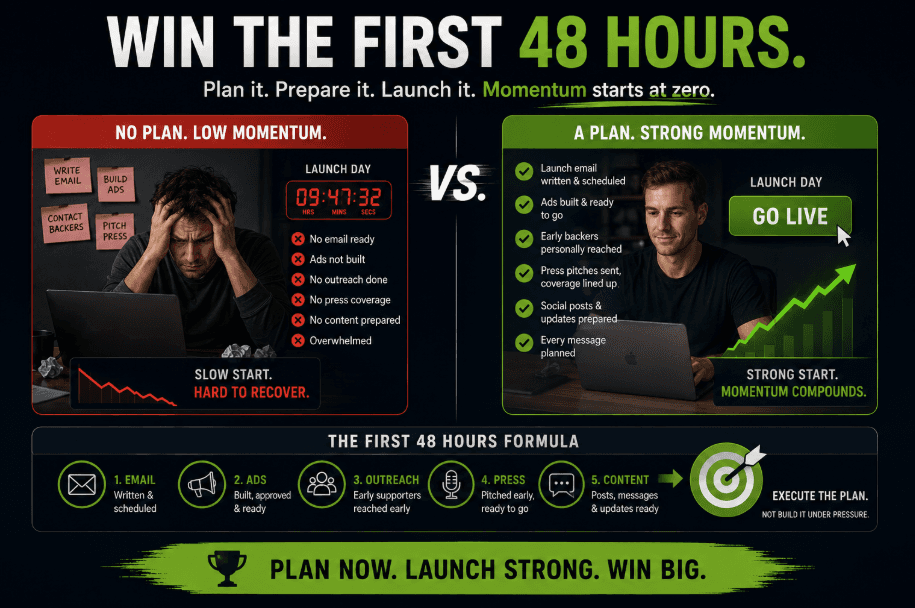
Most first-time creators understand this in the abstract and do almost nothing concrete to prepare for it.
They know the email needs to go out on launch day, but have not written it yet. They plan to turn on ads when the campaign launches, but have not built them yet. They intend to reach out personally to early supporters, but have not done so yet. They want press coverage on launch day, but have not pitched anyone yet.
When launch day arrives, all of those things have to happen simultaneously while also responding to backer messages, monitoring ad performance, posting on social media, and managing everything else that launch day demands. The result is that things happen slowly, inconsistently, or not at all.
A first 48-hour plan, written and executed properly, looks like this. The launch email is written and scheduled to send automatically the moment the campaign goes live. Ads are fully built, approved, and ready to turn on with a single click. Personal outreach to early supporters was done in the weeks before launch, not the morning of. Press pitches went out weeks ago, and some of them are ready to publish on launch day. Every post, every message, every update is drafted and ready.
On launch day, the creator is executing a plan that already exists. Not building one under pressure.
They Treat Paid Ads as a Launch Day Decision
Paid ads work best when they are based on data. Data takes time to generate. Which means the time to start thinking about paid ads is not launch day.
First-time creators often treat paid ads as something they will figure out once the campaign is live. By that point, they are spending real money on campaigns and creatives that have never been tested against real audiences. The early results are expensive and unclear. The budget gets spent on learning that should have happened before the campaign launched.
Pre-launch ads to build the email list are not just about collecting subscribers. They are also about learning. Which audiences respond to your product? Which creative approaches generate the best cost per lead? Which messages resonate with cold traffic and which fall flat? That data, gathered over weeks of pre-launch testing at a modest daily budget, is what makes launch-phase ads efficient rather than experimental.
Creators who run pre-launch ads properly arrive at launch day knowing which audiences to target, which creatives to lead with, and roughly what cost per pledge to expect. They are optimizing rather than guessing. The difference in ad efficiency between these two approaches is significant enough to meaningfully impact the final pledge total.
They Keep the Campaign a Secret Until Launch
There is a version of the pre-launch period where the creator works quietly on the campaign, does not talk about it publicly, and plans to reveal it to the world on launch day.
The reasoning usually goes something like: I do not want someone to steal the idea, or I want to make a big announcement when everything is ready.
This approach almost always backfires.
Building a pre-launch audience requires being visible before you are ready to launch. Generating press interest requires giving journalists lead time. Building community requires showing up consistently in the places your potential backers spend time. All of that takes time, and all of it requires being public about what you are building before the campaign goes live.
The idea theft concern is almost never warranted for physical product campaigns. Your competitive advantage is not the idea. It is your ability to execute, your relationship with your audience, and your head start. Talking about what you are building does not hand that to anyone.
The big announcement framing misunderstands how crowdfunding audiences work. The backers who show up most reliably on launch day are the ones who have been hearing about the campaign for months. Not the ones who discovered it the day it launched.
Be public earlier than feels comfortable. The audience you build in the months before launch is built through consistent, public presence, not through a dramatic reveal.
They Do Not Think About Fulfillment Until After They Fund
Fulfillment is the part of a crowdfunding campaign that most creators think about last and that most frequently causes problems after the campaign ends.
Manufacturing at scale is different from manufacturing a prototype. The costs are different. The timelines are different. The quality control challenges are different. International shipping is expensive, complicated, and subject to delays and customs issues that are genuinely difficult to predict.
Creators who have not thought carefully about fulfillment before they launch often set reward tier prices that do not cover the true cost of delivering the product to every backer. They promise shipping timelines that manufacturing realities make impossible. They do not account for the cost of fulfillment center fees, packaging, inbound freight, or the contingency budget needed for the things that will inevitably go wrong.
The result is a campaign that funds successfully and then spends the following year dealing with delivery delays, angry backers, and margins that do not support the commitments that were made.
Fulfillment planning belongs in the pre-launch phase. Know your manufacturing partners, your fulfillment center options, your shipping rates for your primary markets, and your true cost per unit before you set a goal or price a reward tier. The time to discover that your economics do not work is before you have made promises to hundreds of backers, not after.
The Pre-Launch Phase Is Where Campaigns Are Won or Lost
None of the mistakes in this piece is inevitable. Every one of them is avoidable with enough preparation and enough honest self-assessment before launch day arrives.
The campaigns that raise significant money are not the ones where everything went perfectly. They are the ones where the creator did the hard, unglamorous pre-launch work thoroughly enough that the campaign itself had a real foundation to build on.
Validate early. Build the audience early. Set the goal honestly. Build the page for the backer. Make the video properly. Plan the first 48 hours in detail. Test your ads before you need them to perform. Be public about what you are building. Understand your fulfillment before you make promises you cannot keep.
Do those things, and you walk into launch day with a campaign that is ready. Skip them, and you walk in hoping.
If you want help making sure your pre-launch preparation is solid before your campaign goes live, SVBY has worked with creators through exactly this process and helped them raise over $50,000 on Kickstarter. Book a free 30-minute call, and let's look at where your campaign stands before it matters most.