The Difference Between a $10,000 Kickstarter Campaign and a $100,000 One
May 26, 2026

People assume the gap between a $10,000 campaign and a $100,000 one is the product.
It almost never is.
Spend enough time looking at successful and unsuccessful crowdfunding campaigns, and a pattern emerges that is uncomfortable for a lot of creators to sit with. Products that should have raised a hundred thousand dollars raised ten. Products that seemed unremarkable raised hundreds of thousands. The quality of the idea, the sophistication of the technology, the years of work that went into building the thing, none of it reliably predicts the outcome.
What predicts the outcome is almost everything that happens outside the product itself.
This is not a cynical observation. It is actually an encouraging one. Because the things that separate a $10,000 campaign from a $100,000 one are learnable, plannable, and executable by any creator willing to do the work properly.
Here is what those things actually are.
The Audience They Showed Up With
This is the biggest single difference between campaigns that raise a lot and campaigns that raise a little, and it is built entirely before the campaign goes live.
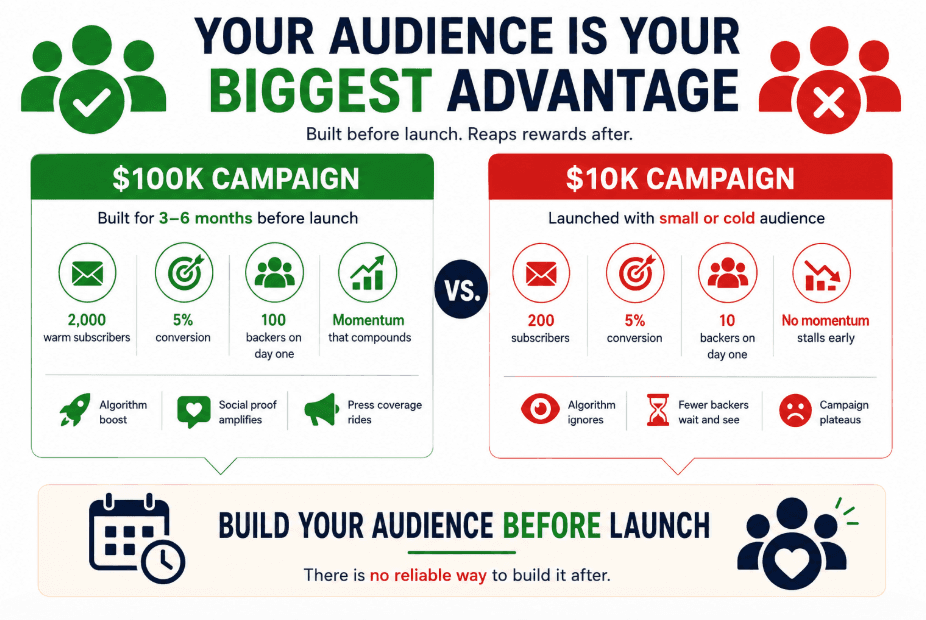
A $100,000 campaign almost never gets there by finding its audience after launch. It gets there because the creator spent three to six months before launch building a list of people who were already interested, already warm, and already waiting for the moment to back.
A $10,000 campaign typically launches to a small, cold, or nonexistent pre-built audience and then relies on the platform, paid ads, and organic discovery to do the work that should have been done in the months before launch. Sometimes that works. Usually, it produces a campaign that funds narrowly and plateaus early.
The math is not complicated. A creator who shows up on launch day with 2,000 warm email subscribers and converts five percent of them has 100 backers on day one before a single ad runs or a single organic visitor arrives. That kind of opening creates momentum that the algorithm picks up, that social proof amplifies, and that press coverage rides. Everything that follows is easier.
A creator who launches with 200 subscribers and converts the same percentage has ten backers on day one. The campaign looks flat. The algorithm ignores it. Backers who were on the fence decide to wait and see. The campaign never builds the momentum it needs.
The audience is built before launch, or it is not built at all. There is no reliable way to build it after the campaign is live.
How They Treated the First 48 Hours
A $100,000 campaign treats the first 48 hours like the most important operational window of the entire campaign, because it is.
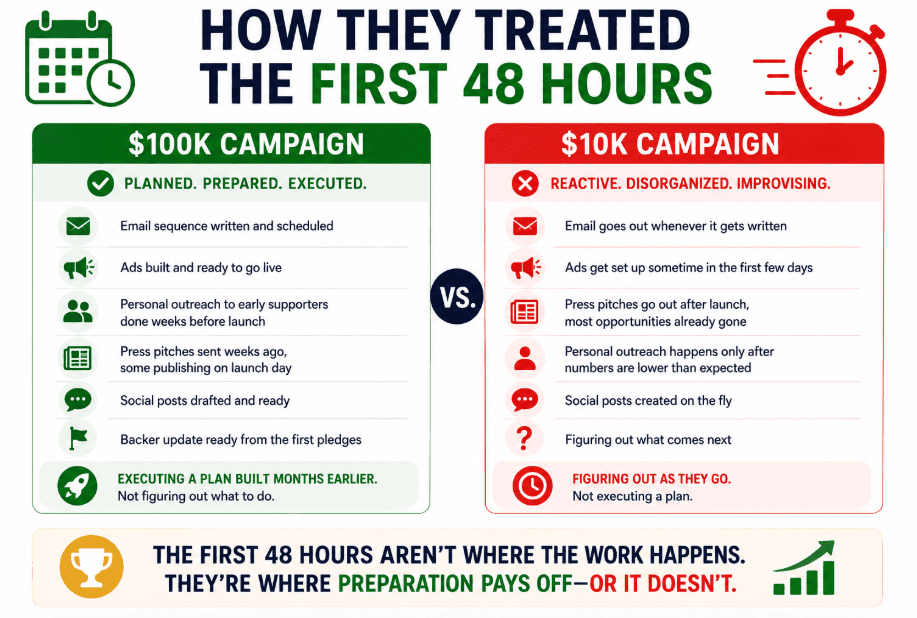
Everything is planned in advance. The email sequence is written and scheduled. The ads are built and ready to go live the moment the campaign launches. The personal outreach to early supporters was done weeks before launch, not the morning of. The press pitches went out weeks ago, and some of them are ready to publish on launch day. The social posts are drafted. The backer update is ready to go the moment the first pledges come in.
On launch day, the creator is executing a plan they built months earlier. They are not figuring out what to do. They are doing what they already decided to do.
A $10,000 campaign launches and then figures out what comes next. The email goes out whenever it gets written. The ads get set up sometime in the first few days. The press pitches go out after the campaign is live, when most of the opportunities have already passed. The personal outreach happens after the creator notices that the numbers are lower than expected.
The first 48 hours of a campaign are not where the work happens. They are where the preparation either pays off or it does not. A creator who has done the preparation executes confidently. A creator who has not spent those critical hours improvising.
The Campaign Page They Built
Both campaigns have a page. One of them is a sales page. The other one is a product description.
A $100,000 campaign page opens with the problem in a way that the target backer immediately recognizes from their own life. It builds an emotional case before it makes a rational one. It uses images and copy together in a way that carries someone from curious visitor to convinced backer without them having to work hard to understand what they are looking at. The reward tiers are clear, logically priced, and structured so that the right tier for most backers is obvious within seconds.
A $10,000 campaign page leads with the product. It lists features. It uses language like innovative and revolutionary. It includes a lot of information that the creator found important, but that the potential backer did not need to make a decision. The reward tiers are confusing, too numerous, or priced in a way that does not quite make sense. The call to action is weak or absent.
The difference in conversion rate between these two pages is enormous. If ten percent of the traffic to the first page converts into backers and three percent of the traffic to the second page converts, that gap compounds across every visitor the campaign receives from every source. The same ad spend, the same press coverage, the same organic traffic produce dramatically different pledge totals depending on what happens when someone arrives at the page.
A campaign page is a conversion tool. The $100,000 campaigns treat it that way from the first draft. The $10,000 campaigns often discover this too late to do anything about it.
The Video They Made
The $100,000 campaign video opens with the problem. Not a logo. Not a slow pan across a landscape. Not an upbeat music intro. The problem is shown in a way that makes the viewer feel something in the first five seconds.
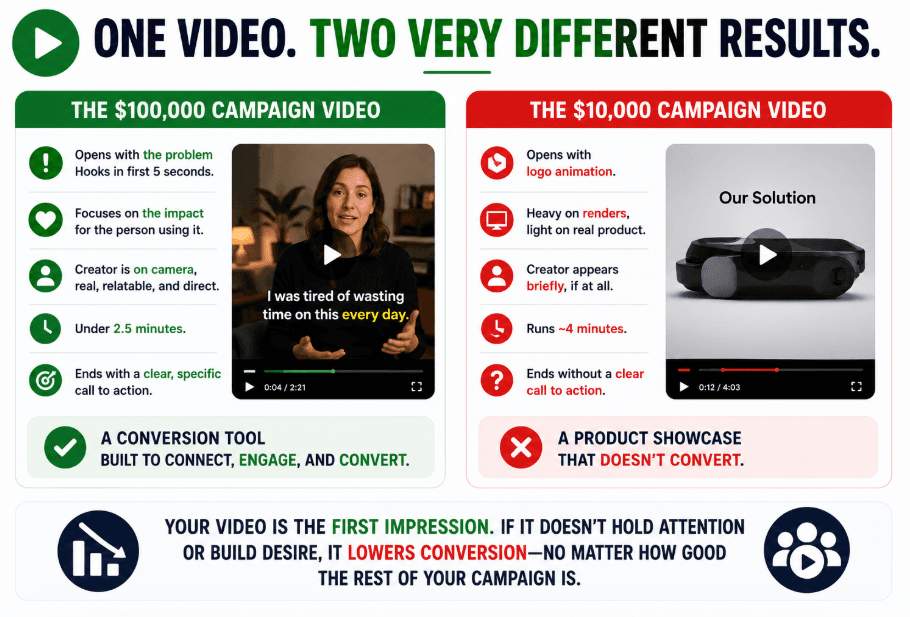
It spends more time on what the product means for the person using it than on what the product technically does. It shows the creator on camera, speaking directly, looking like a real human being who built a real thing for a real reason. It ends with a clear and specific call to action that tells the viewer exactly what to do next.
It is probably under two and a half minutes long.
The $10,000 campaign video opens with a logo animation. It runs for four minutes. It is heavy on renders and light on actual product footage. The creator appears briefly, if at all. It ends without clearly telling the viewer what to do.
Both creators made a video. One made a conversion tool. The other made a product showcase that does not convert.
The video is the first thing most visitors engage with on a campaign page. A video that fails to hold attention or fails to build desire does not just miss an opportunity. It actively reduces the conversion rate of everything else on the page.
How They Spent Their Marketing Budget
A $100,000 campaign spends its marketing budget based on data. It tests audiences and creatives during the pre-launch period at a small scale, identifies what is working, and scales the things that perform into the launch phase with confidence. Budget is allocated across pre-launch, launch week, mid-campaign, and the final push in proportions that make strategic sense. The final days of the campaign get meaningful spend because the creator knows that urgency-driven conversion is at its highest in that window.
A $10,000 campaign spends its marketing budget based on intuition and hope. It launches ads on launch day without meaningful pre-launch testing. It scales up quickly based on early impressions rather than actual conversion data. It ran out of budget before the final push because too much was spent in the first week before the campaign had found its stride. Or it underspends throughout because the creator was nervous about wasting money and never gave the ads enough budget to generate meaningful data.
The creators running $100,000 campaigns are not necessarily smarter or more experienced with advertising. They are more disciplined about letting data drive decisions rather than feelings.
The Social Proof They Built
A $100,000 campaign arrives on launch day with social proof already in place. Press coverage that was pitched and secured weeks before launch. Early reviews from people who tested the prototype. A backer community that was built in a Facebook group or Discord during the pre-launch period. A number of pre-launch signups signal to the algorithm and to early visitors that this campaign is real and has genuine interest behind it.
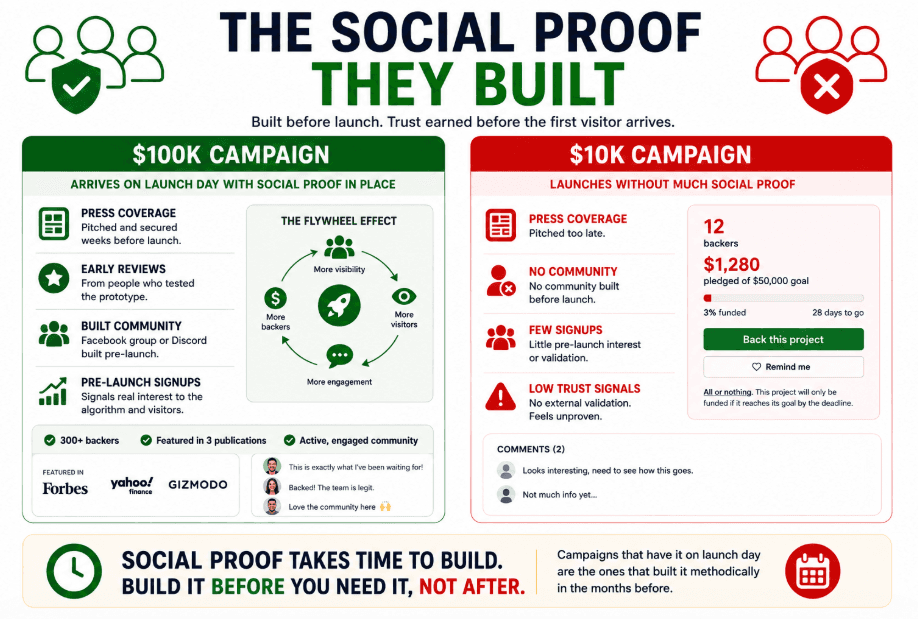
That social proof creates a flywheel. A visitor who arrives and sees that 300 people have already backed the campaign, that it has been featured in three relevant publications, and that the comments section is full of engaged early backers makes a very different risk calculation than a visitor who arrives and sees a campaign with 12 backers and no external validation.
A $10,000 campaign often launches without much of this. The press coverage was pitched too late. The community was not built before launch. The first visitors arrive at a page that looks like it has not found its audience yet, because it has not.
Social proof takes time to build, and it has to be built before you need it, not after. The campaigns that have it on launch day are the ones that built it methodically in the months before.
How They Handled the Mid-Campaign Slump
Every campaign that runs longer than two weeks hits a slow period in the middle. The warmest audience has converted. The algorithm has moved on to newer campaigns. The initial excitement has faded.
A $100,000 campaign saw this coming. It had a stretch goal ready to announce. It was fresh, creative, and ready to deploy. It had mid-campaign email sequences written. It had community outreach planned for forums and groups it had not yet tapped. It had a budget held back specifically for this period so it could keep its ads running and even scale them when other campaigns were running dry.
A $10,000 campaign was surprised by the slump. It had not planned for it. When pledges stopped coming in, the creator refreshed the page, adjusted a few things without a clear strategy, and hoped things would pick back up. Sometimes they did a little. Often they did not.
The mid-campaign slump is not a crisis if you planned for it. It becomes one if you did not.
The Relationship They Built With Their Backers
A $100,000 campaign treats its existing backers as one of its most valuable marketing assets, because they are.
Backer updates go out regularly throughout the campaign. They are personal, substantive, and give backers something worth sharing. They make backers feel like insiders rather than customers, which turns them into advocates who bring new backers to the campaign without being asked.
The creator responds to every comment and message. When questions come up in the campaign comments that reveal a gap in the page, the creator updates the page to address them. The community around the campaign feels alive and managed.
A $10,000 campaign sends fewer updates. The creator is overwhelmed by everything else, and backer communication feels like a lower priority than marketing. Comments go unanswered for days. Backers who would have shared the campaign if they had felt more connected to it stay silent instead.
The backers you already have are the most cost-effective source of new backers available to you. Treating them well is not just the right thing to do. It is a growth strategy.
The Final Push They Executed
The last three to five days of a crowdfunding campaign almost always produce a spike in pledges as the deadline creates genuine urgency. What separates a $10,000 final push from a $100,000 final push is almost entirely preparation and budget.
A $100,000 campaign enters its final days with reserved ad budget ready to deploy, retargeting audiences full of warm leads who visited the page throughout the campaign, final urgency emails ready to send, and a clear message about what happens after the campaign closes for people who have not backed yet.
The final push feels like a closing argument because it is one. Every piece of communication in those last few days is designed to convert the people who have been watching from the sidelines and give them a specific and honest reason to act before the deadline.
A $10,000 campaign enters its final days with its budget mostly spent, its retargeting audiences thin, and no clear plan for how to maximize the natural urgency of the countdown. The spike that should have happened in the final days is smaller than it could have been because the preparation for it was not done.
None of This Is About the Product
Read back through everything above and notice what is not mentioned anywhere.
The technology. The innovation. The years of development. The sophistication of the engineering. The quality of the materials. How clever the solution is.
None of those things is what separates a $10,000 campaign from a $100,000 one.
That is the part that is hard to hear if you have spent years building something genuinely excellent. Excellence in the product is the foundation. It is necessary. But it is not sufficient. The campaigns that raise significant money are the ones where excellence in the product is matched by excellence in execution across every other dimension of the campaign.
The good news is that everything in this piece is learnable. None of it requires talent you either have or do not have. It requires preparation, discipline, and a willingness to treat your campaign like the serious undertaking it is, rather than hoping that a great product will do the work on its own.
If you want help figuring out what your specific campaign needs to get from where it is to where you want it to be, SVBY has guided campaigns through exactly this process and helped them raise over $50,000 on Kickstarter. Book a free 30-minute call, and let's look honestly at what is standing between your campaign and the result you are aiming for.