How to Launch a Crowdfunding Campaign From a Country Not Supported by Kickstarter
May 4, 2026
You have a product worth funding. You have done the research, built the prototype, and figured out that crowdfunding is the right way to bring it to life. Then you check Kickstarter's list of supported countries and find out yours is not on it.
It is a frustrating moment. But it is not the end of the road.
Thousands of creators from countries outside Kickstarter's supported list have successfully launched campaigns, raised significant money, and built real businesses from their crowdfunding success. The path is just a little more involved than it is for creators in the US, UK, or Canada.
This guide walks through your actual options, what each one involves, and how to make the right choice for your specific situation.
First, Understand Why Kickstarter Has Country Restrictions
Kickstarter is not being arbitrary with its country list. The restrictions exist because of payment processing, banking regulations, and legal requirements that vary significantly from country to country.
To receive funds from a Kickstarter campaign, you need a bank account in a supported country, a valid address in that country, a government-issued ID from that country, and a taxpayer identification number or equivalent.
Kickstarter processes payments through Stripe, which has its own list of supported countries that is more limited than most people expect. If Stripe does not operate in your country, Kickstarter cannot process your payouts there. It is a financial infrastructure problem, not a policy choice.
Understanding this makes the solutions clearer. You are not trying to convince Kickstarter to make an exception. You are trying to create a legitimate structure that satisfies the actual requirements.
Option One: Use Indiegogo Instead
The simplest path for creators in unsupported countries is to use Indiegogo rather than Kickstarter.
Indiegogo supports a significantly broader range of countries through its payment processing partnerships. If your country is not on Kickstarter's list, there is a reasonable chance it is on Indiegogo's. Check their current supported country list directly, as it updates more frequently than most guides like this one.
Beyond broader country support, Indiegogo has a few structural advantages that can work in favor of creators who do not have the built-in Kickstarter community behind them. Flexible funding means you keep whatever you raise, even if you do not hit your goal. InDemand lets you continue collecting pre-orders after your campaign ends. And Indiegogo's audience skews toward technology and hardware products, which tends to be where internationally based creators are launching.
The honest trade-off is that Kickstarter still has stronger organic discovery and a larger, more engaged backer community. If your product is a strong fit for Kickstarter's audience and you have the means to launch there, it is worth the extra steps. But if the choice is between a Kickstarter campaign you cannot legally run and an Indiegogo campaign you can, Indiegogo is an entirely legitimate path that has produced campaigns raising millions of dollars.
Option Two: Register a Company in a Supported Country
This is the route most serious creators take when they are committed to launching on Kickstarter specifically.
Kickstarter requires a legal entity, a bank account, and a verified address in a supported country. You can satisfy all three requirements by registering a company in a country where Kickstarter operates.
The United States is the most common choice for this because of the size of the Kickstarter backer community there, the credibility that a US entity tends to carry with international backers, and the relatively straightforward process for foreigners to register an LLC.
A US LLC can be registered remotely by non-US residents. You do not need to travel to the US. You do not need a US visa. Services like Stripe Atlas, Doola, and Northwest Registered Agent handle the registration process and provide a registered address as part of their offering. The process typically takes one to three weeks and costs a few hundred dollars in service fees plus state filing fees.
Once your LLC is registered, you need a US bank account to receive Kickstarter payouts. This is the step that catches most people off guard, because most US banks require you to be physically present to open a business account. Mercury Bank and Relay Financial are two online business banks that allow non-US residents to open accounts remotely, provided you have a registered US entity. Both are legitimate, widely used by international founders, and compatible with Stripe and Kickstarter payouts.
The full setup, LLC registration plus business bank account, typically costs between three hundred and eight hundred dollars and takes two to four weeks. That is a meaningful investment, but for a creator planning a serious campaign, it is a one-time cost that also gives you a legitimate US business entity you can use for ongoing operations, future campaigns, and e-commerce after the campaign ends.
Option Three: Partner With Someone in a Supported Country
Some creators in unsupported countries partner with a trusted individual or business entity in a supported country who serves as the official Kickstarter account holder.
This can work, but it comes with real risks that are worth understanding before you go down this path.
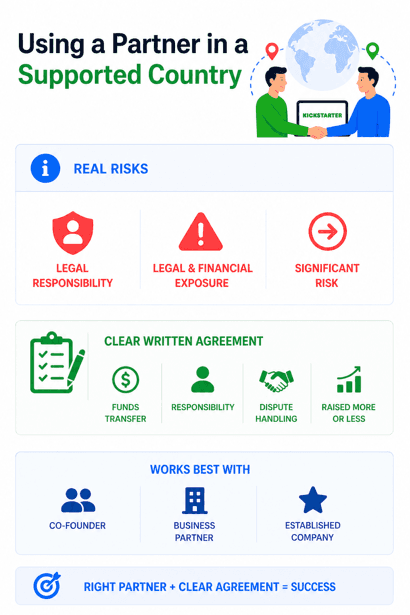
The person whose name is on the Kickstarter account is legally responsible for the campaign and the funds it raises. If something goes wrong with production, fulfillment, or backer refunds, the legal and financial exposure sits with them. That is a significant thing to ask of anyone, including a close friend or business partner.
If you go this route, make sure you have a clear written agreement that covers how funds will be transferred to you, who is responsible for what, how disputes will be handled, and what happens if the campaign raises significantly more or less than expected. Do not rely on a handshake arrangement when real money is involved.
This option works best when the partner is someone with a genuine stake in the campaign's success, such as a co-founder, a business partner who is already involved in the product, or an established company that is taking on the campaign as a formal arrangement rather than a personal favor.
What About Using a Friend or Family Member's Account?
This comes up a lot, and the answer is straightforward. Do not do it.
Kickstarter's terms of service are clear that campaigns must be run by the person or entity that is legally responsible for delivering the rewards. Using someone else's account without disclosing the actual creator's identity violates those terms and can result in the campaign being suspended, funds being withheld, and the account holder being permanently banned.
Beyond the platform risk, you are putting your backer relationships at risk. If backers discover that the person running the campaign is not who they thought they were dealing with, the trust damage can be severe. Crowdfunding runs on trust. Anything that undermines it is a risk not worth taking.
Handling Taxes as an International Creator
This is the part most guides skip over, and it is genuinely important.
If you register a US LLC and raise money through a US Kickstarter campaign, you will have US tax obligations. Exactly what those obligations look like depends on your country of residence, whether your LLC is structured as a single-member or multi-member entity, and several other factors that vary by individual situation.
The general principle is that you will likely need to file a US tax return for the LLC and pay applicable taxes on the income it earns. You may also have tax obligations in your home country, depending on how funds flow between the US entity and yourself personally.
Do not navigate this without professional help. An accountant who has experience with international founders and US LLCs is worth the cost of a few sessions. The rules are complicated enough that guessing your way through them creates real financial risk.
Get the tax structure right before the campaign goes live, not after it ends.
Currency and Transfer Fees
Once your campaign funds and Kickstarter release the money into your US bank account, you need to get it from there to wherever you actually need it, which is usually your home country.
Standard international wire transfers are expensive and slow. Banks charge significant fees on both ends, and exchange rates are rarely favorable.
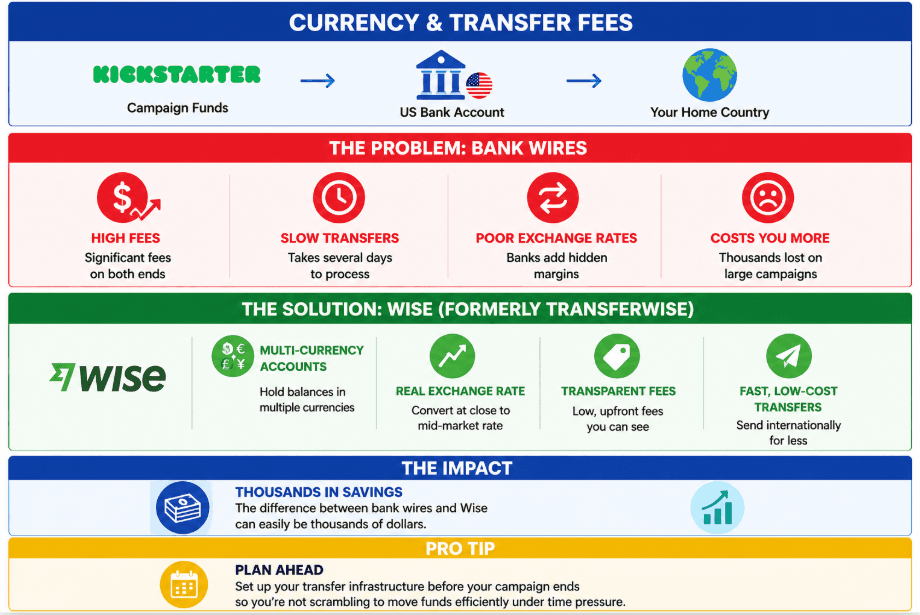
Services like Wise, formerly TransferWise, exist specifically for this problem. Wise allows you to hold balances in multiple currencies, convert at close to the mid-market rate with transparent fees, and transfer internationally at a fraction of what traditional banks charge. For an international creator moving campaign funds across borders, the difference between using a bank wire and using Wise can easily be thousands of dollars on a significant campaign.
Set up your transfer infrastructure before your campaign ends so you are not scrambling to move funds efficiently under time pressure.
Telling Your Backers the Truth
One question that comes up for creators who register a US entity is whether they need to tell backers they are not based in the US.
The answer is that honesty is always the right policy, and transparency almost always helps rather than hurts.
Backers understand that products are made all over the world. What they care about is whether the creator is trustworthy, whether the product is real, and whether they will receive what they paid for. A creator from India, Nigeria, Brazil, or anywhere else who is open about where they are based and has a clear and credible plan for delivering on their promises will earn more trust than a creator who obscures their location and leaves backers wondering.
If your campaign page tells the story of who you are and where you are building, and that story is genuine, most backers will respond to that positively. The crowdfunding community has backed creators from every corner of the world. What it does not forgive is deception.
Practical Steps to Get Started
If you are committed to launching on Kickstarter from an unsupported country, here is the sequence that makes the most sense.
Start by confirming that your country is actually not supported, because Kickstarter updates its list periodically, and information online is not always current. Check directly on Kickstarter's website.
If you are not supported, decide whether Indiegogo meets your needs before investing in a US entity. For many creators, it genuinely does, and the simpler path is the right one.
If you want to launch on Kickstarter specifically, begin the US LLC registration process through a reputable service. Allow two to four weeks for the full process, including the bank account setup.
While that is in progress, continue building your pre-launch email list and campaign assets. The entity setup runs in parallel with your campaign preparation, not instead of it. Use that time well.
Once your entity and bank account are in place, get clear on your tax obligations before you launch. Talk to an accountant who understands international founder situations.
Then build your campaign the same way any serious creator would. Strong page, warm audience, launch day plan, paid ads strategy. Your location does not change what makes a crowdfunding campaign succeed. The fundamentals are the same regardless of where you are based.
Where You Are From Is Not the Barrier You Think It Is
Kickstarter's country restrictions are a real administrative hurdle. They are not insurmountable ones.
The creators who let the country's restrictions stop them are the ones whose campaigns never happen. The ones who treat it as a logistical problem to solve, the same way they solve every other logistical problem that comes with bringing a product to life, are the ones who launch, fund, and build something real.
The work involved in setting up a US entity and bank account is genuinely worth it if your campaign is ready to go and your product has real demand. Think of it as the entry fee for accessing the world's largest crowdfunding audience.
If you want help figuring out whether your campaign is ready to launch and what the right platform and structure looks like for your specific situation, SVBY works with creators from around the world. Book a free 30-minute call, and let's figure out the path that makes the most sense for you.