How to Get Press Coverage for Your Crowdfunding Campaign
May 12, 2026
Most crowdfunding creators think about press coverage the way they think about going viral. Something that would be amazing if it happened, probably will not happen to them, and is mostly outside their control.
That is the wrong way to think about it.
Press coverage is not luck. It is not reserved for campaigns with massive budgets or founders with existing media relationships. It is a skill, and like most skills, it can be learned, practiced, and systematically applied to produce results.
The creators who consistently get their campaigns featured in relevant publications, newsletters, and podcasts are not the ones with the best products or the most interesting stories. They are the ones who understand how media works, what journalists and writers actually need from a pitch, and how to make covering their campaign as easy as possible for someone with seventeen other things on their to-do list.
This guide covers how to do exactly that.
Understand What Journalists Actually Want
Before you write a single pitch, you need to genuinely understand the perspective of the person you are pitching to.
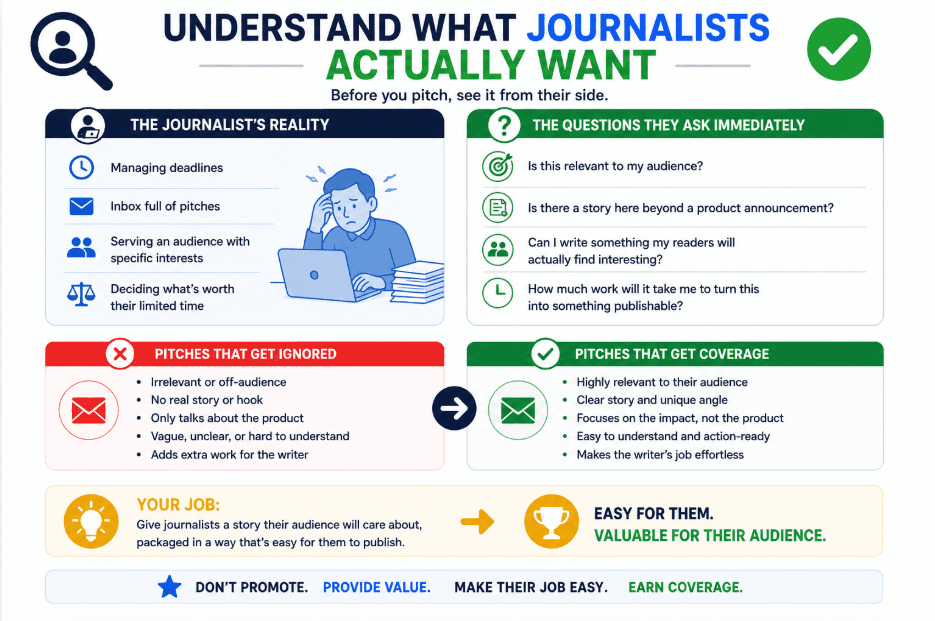
A journalist or newsletter writer is not sitting at their desk hoping someone will send them a great crowdfunding campaign to write about. They are managing deadlines, dealing with an inbox full of pitches, trying to serve an audience that has specific interests and expectations, and making judgment calls all day about what is worth their limited time and what is not.
When a pitch lands in their inbox, they are asking a small number of questions almost immediately. Is this relevant to my audience? Is there a story here beyond a product announcement? Can I write something my readers will genuinely find interesting? And critically: how much work will it take me to turn this into something publishable?
The pitches that get ignored are the ones that answer those questions poorly or not at all. The pitches that get coverage are the ones that make the answers obvious and make the writer's job as easy as possible.
Your job is not to tell journalists how great your product is. Your job is to give them a story their audience will care about, packaged in a way that requires minimal effort on their part to turn into a piece of content.
Build Your Press List Before You Launch
Press outreach that starts on launch day is press outreach that arrives too late.
Journalists and newsletter writers plan their content in advance. A writer who would have been happy to cover your campaign if they had known about it two weeks before launch has already filled their editorial calendar by the time your launch day pitch arrives. The coverage you could have had goes to someone else who reached out earlier.
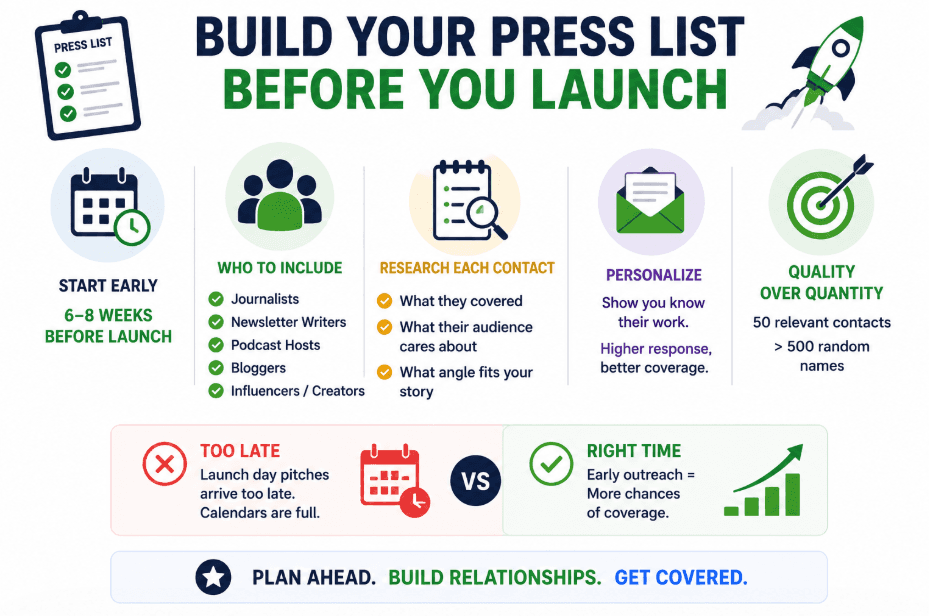
Start building your press list at least six to eight weeks before your campaign goes live. The list should include journalists at publications your target backers read, newsletter writers in your product's niche, podcast hosts whose audience matches your backer profile, bloggers who cover your category, and any influencers or content creators whose following overlaps meaningfully with who you are trying to reach.
For each person on your list, note what they have covered recently, what their audience cares about, and what angle might make your campaign relevant to them specifically. A personalized pitch that demonstrates you actually read their work converts at a dramatically higher rate than a mass email that could have been sent to anyone.
Quality matters more than quantity here. A press list of fifty genuinely relevant contacts you have researched properly is more valuable than a list of five hundred names you scraped from a media database without any context.
Find Your Story, Not Your Product
The single most important thing to understand about press pitching is that journalists do not write about products. They write about stories.
Your product is not a story. Your product is a thing. The story is what surrounds it, what motivated it, what problem it solves and for whom, what was surprising or difficult or unexpected about building it, what it says about a larger trend or shift in the world.
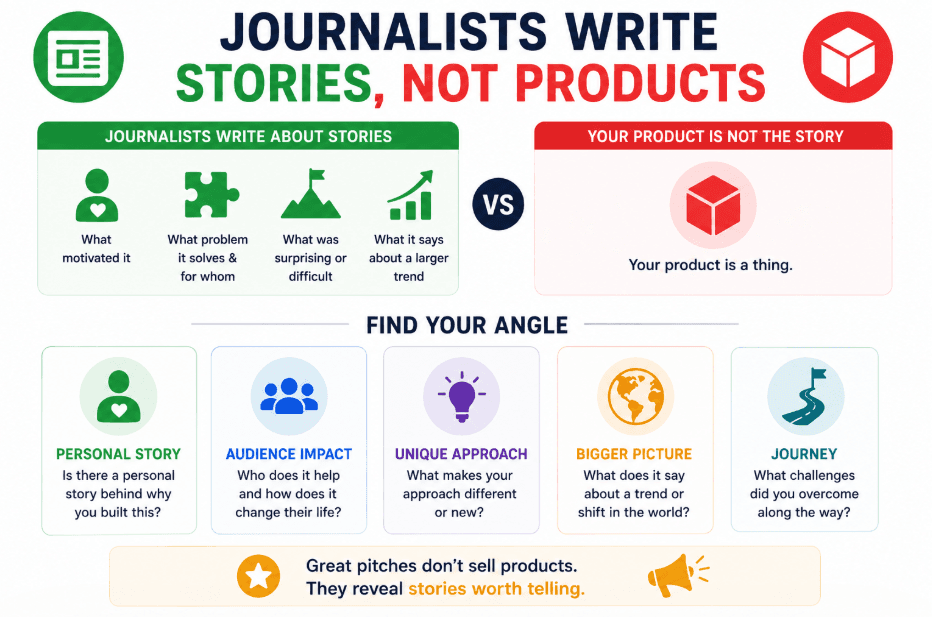
Before you write a single pitch, spend time identifying the angles that could make your campaign genuinely interesting to an outside audience. Some questions that help with this:
Is there a personal story behind why you built this? A founder who built a product to solve a problem they personally experienced is a more compelling story than a founder who identified a market opportunity.
Does your product challenge a dominant player or an industry assumption? David and Goliath stories are perennially interesting to journalists and to audiences.
Is there a surprising insight your product is built on? Something that most people believe about your category that turns out to be wrong?
Does your campaign connect to a larger cultural trend that journalists are already writing about? A product that fits into an existing conversation is much easier to place than one that requires a writer to explain an entirely new context.
Is there data or research behind the problem your product solves that a journalist could use to anchor a broader piece? Numbers make stories more credible and more shareable.
You may have multiple angles available. Different angles will be relevant to different publications. A tech publication wants a different hook than a lifestyle magazine, which wants a different hook than a niche industry newsletter.
Write a Pitch That Gets Read
Most press pitches are too long, too self-promotional, and too focused on the sender rather than the recipient.
A pitch that gets read is short. Three to five short paragraphs maximum. A journalist who opens an email and sees a wall of text closes it. Your pitch needs to communicate its core value in the first two sentences, or it is not going to get a fair reading.
The subject line is the most important line in the pitch. It determines whether the email gets opened at all. Keep it specific, keep it relevant to the writer's beat, and make it about the story rather than the product. A subject line like "Crowdfunding campaign launches portable espresso maker" is a product announcement. A subject line like "The $51k Kickstarter campaign proving commuters will pay for real coffee" is a story.
The opening line of the pitch should immediately answer why you are reaching out to this specific person and why their audience would care. Reference something they have written recently, if you can do it genuinely. A sentence that shows you actually know their work is worth more than three paragraphs of product description.
Then deliver the story in two to three sentences. What is happening, why it is interesting, and why it is relevant now. Be specific. Concrete details are more persuasive than vague claims.
Close with a short description of the product and campaign, a link, and an offer to provide whatever they need: samples, interviews, additional images, data, whatever makes writing the piece easier.
Do not attach large files to the first pitch. Do not include lengthy press releases. Do not write three paragraphs about your background before you have given the journalist a reason to care.
Short, specific, story-first, easy to act on. That is the formula.
Time Your Outreach Strategically
When you reach out, it matters almost as much as how you reach out.
The pre-launch pitch is your most powerful tool and the one most creators never use. Reaching out to journalists four to six weeks before your campaign goes live gives them time to plan coverage, request samples if they want them, schedule interviews, and write something thoughtful rather than reactive.
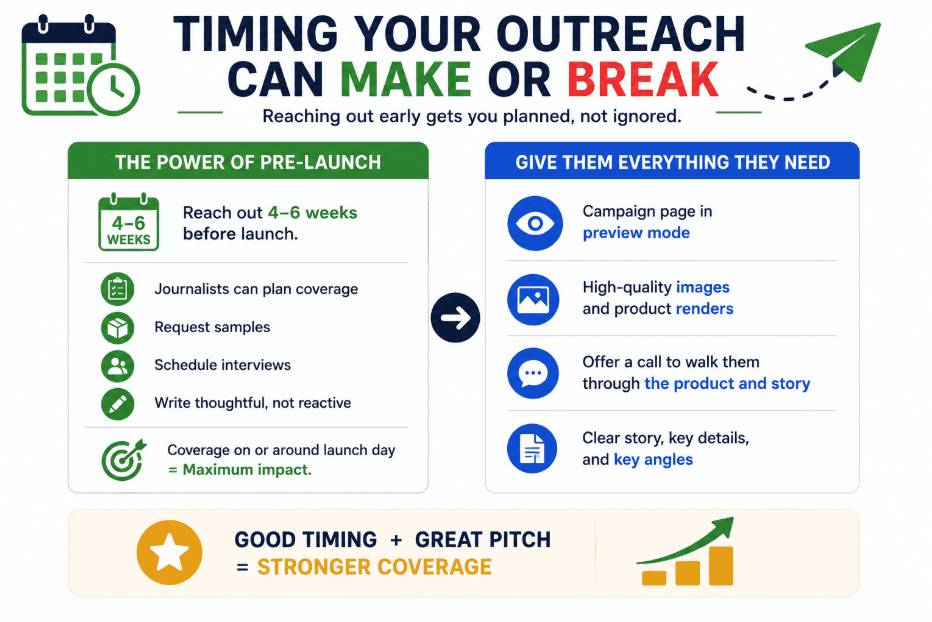
A journalist who receives a pre-launch pitch and decides it is worth covering can plan to publish their piece on or around your launch day, which is exactly when you want the traffic. That kind of coordinated coverage is not available to creators who only reach out after they have already gone live.
Your pre-launch pitch should give the writer everything they need to understand the story without requiring them to wait for the campaign to launch. Share your campaign page in preview mode if the platform allows it. Provide high-quality images and product renders. Offer a phone or video call to walk them through the product and the story behind it.
On launch day, follow up with anyone who expressed interest during the pre-launch period. Let them know the campaign is live, share the link, and make it as easy as possible for them to publish what they have been preparing.
During the campaign, continue outreach to journalists and writers you have not yet reached. A campaign that is already funded to a meaningful degree is actually a better story than one that just launched, because it demonstrates validated demand. A headline that says "Kickstarter campaign raises $30,000 in first week" is more compelling to a journalist than "Kickstarter campaign launches."
Make the Asset Package Impossible to Say No To
Journalists who decide to cover your campaign still have to actually write the piece. The easier you make that for them, the more likely coverage turns into published content rather than a good intention that never quite happened.
Prepare a press kit that contains everything a writer might need without them having to ask for it.
High-resolution product images are essential. Not screenshots from your campaign page. Properly lit, properly composed photographs at a resolution that works for print as well as digital. A journalist who wants to cover your campaign and cannot find a usable image may simply not cover it.
A short, factual summary of the campaign. One page maximum. What the product is, what problem it solves, what the funding goal is, how much has been raised, when the campaign ends, and where to find it. No marketing language. Just clear, accurate information a journalist can quote or reference without having to rewrite.
A brief founder bio that explains who you are and why you built this. One paragraph is enough. Make it human and specific rather than corporate and vague.
Key data points that a journalist could use to anchor their piece. The size of the market you are addressing, the scale of the problem your product solves, and any research or statistics that make the story feel significant.
A clear and direct offer for whatever the journalist might need next. Samples of the product lends itself to review. A phone or video interview. Access to early backers for quotes. Whatever makes writing the piece easier.
Distribute this package through a shared folder link rather than email attachments. It is easier to access, easier to share with editors, and more likely to be used.
Follow Up Without Being Annoying
Most pitches that do not get a response on the first try are not being ignored because the journalist is not interested. They are being buried under the volume of everything else in a busy inbox.
A single follow-up email five to seven days after your initial pitch is completely appropriate and often necessary. Keep it short. Reference your original pitch, add one new piece of information or development if you have one, and ask directly whether this is something they would consider covering.
Do not follow up more than twice. A journalist who has not responded after two touches has either decided it is not a fit or is genuinely too busy to respond right now. Continued follow-up after that moves from persistence to nuisance, and nuisance is the last impression you want to leave with someone you might want to pitch again in the future.
If someone responds and says it is not a fit for their publication right now, thank them, ask if they know someone else who might be interested, and move on. A journalist who respects that you handled their no gracefully is more likely to remember you positively for a future pitch.
Think Beyond the Obvious Publications
Most crowdfunding creators pitch the same obvious targets. TechCrunch, Wired, Mashable, and the major general interest publications that everyone recognizes. The competition for coverage in those outlets is intense, and the editorial bar is high.
Some campaigns do land coverage in major outlets, and it can be transformative when it happens. But betting your entire press strategy on a TechCrunch feature is a mistake.
The publications that drive the most qualified backer traffic are often much smaller and more niche. A newsletter with 10,000 engaged subscribers who are exactly your target backer profile will drive more pledges than a mention in a publication with 10 million readers who mostly are not.
Think carefully about where your specific backer actually spends time online. What do they read? What newsletters are they subscribed to? What podcasts do they listen to during their commute? What YouTube channels do they watch? What Reddit communities are they part of?
The answers to those questions give you a press list that is smaller than the obvious targets but far more relevant to your campaign. A feature in a niche outdoor gear newsletter for a camping product will drive more camping enthusiasts to your Kickstarter than a brief mention in a general tech publication.
Treat Podcast Outreach Separately
Podcasts deserve their own strategy because they work differently from written press and often produce better results for the effort involved.
A podcast host who covers your campaign does not just give you a link. They give you fifteen to thirty minutes of audio where their audience, who already trust this host's recommendations, hears the story of your product in detail from someone who has vouched for it. That level of engagement is not available through any other press channel.
Podcast outreach takes longer to convert than written press because recording, editing, and publishing take time. Start your podcast outreach eight to ten weeks before your campaign if you can. A podcast episode that publishes during your campaign window rather than after it closes is worth significantly more.
When pitching podcasts, lead with what you can offer the audience rather than what you want from the coverage. What story can you tell on their show that their listeners will genuinely find valuable? What expertise do you have from building your product that your audience would benefit from hearing? Make the pitch about the value you bring to their show, not about the exposure you want from it.
Press Coverage Compounds
One piece of coverage makes the next piece of coverage easier to get.
A journalist who is considering covering your campaign and sees that a respected publication in their space has already featured it is more confident that it is worth their time. Social proof works on journalists the same way it works on backers.
Keep a running record of every piece of coverage your campaign receives and include it in your subsequent pitches. A press section on your campaign page that shows logos of publications that have covered you builds trust with both journalists and backers.
The first piece of coverage is the hardest to get. After that, each subsequent piece of coverage makes the next one more achievable. Start with the most accessible targets on your list, the smaller niche publications and newsletters that are genuinely aligned with your product, and use those early wins to build credibility with larger outlets.
Press coverage is a skill that gets easier the more you practice it. The campaign you run today is also preparation for the campaign you run next time, when you already have relationships, a track record, and a clearer sense of what stories resonate.
If you want help developing a press strategy for your crowdfunding campaign and making sure your pitches are positioned to land coverage, SVBY has worked with campaigns that raised over $50,000 on Kickstarter. Book a free 30-minute call, and let's talk through what your campaign needs.