Why Your Crowdfunding Video Is Killing Your Conversion Rate
May 11, 2026

Kickstarter's own data has said it for years. Campaigns with videos raise more money than campaigns without them. Most creators read that stat, nod, and immediately go make a video that actively hurts their campaign.
Not because they did not try. Because nobody told them what actually makes a crowdfunding video work, and what makes one quietly drain the conversion rate of an otherwise solid campaign page.
The video is the first thing most visitors engage with on your campaign page. Before they read your copy, before they look at your reward tiers, before they decide whether to scroll down at all, they watch the video. Or they do not. And if they do not, or if they watch it and walk away unconvinced, everything else on your page gets far less of a chance to do its job.
This is why a bad video does not just fail to help. It actively makes your campaign perform worse than it would with no video at all.
Here is what is going wrong in most crowdfunding videos, and how to fix it before your campaign goes live.
You Open With the Wrong Thing
The first five seconds of your video determine whether someone keeps watching or clicks away. Most crowdfunding videos waste those five seconds on something that does nothing to hold attention.
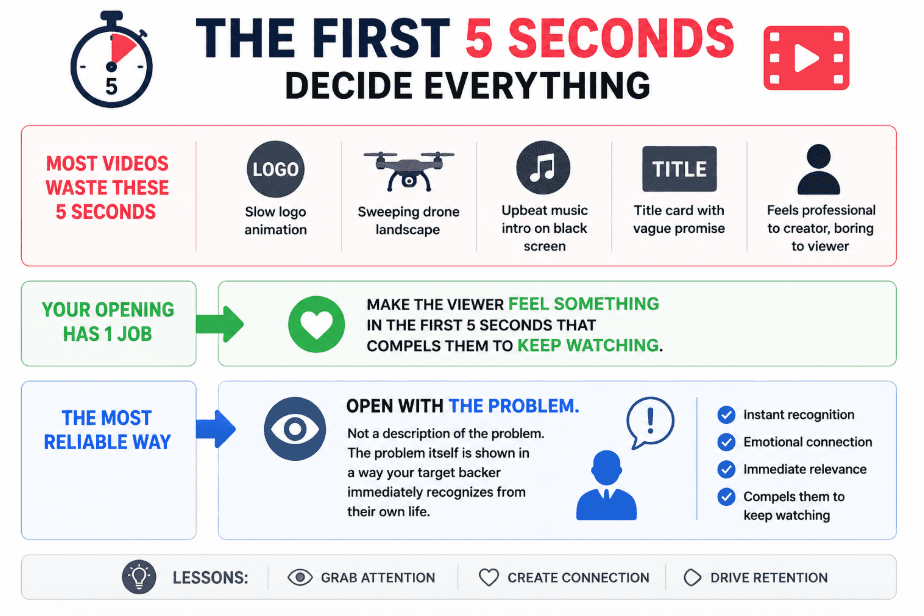
A slow logo animation. A sweeping drone shot of a landscape. An upbeat music intro over a black screen. A title card that reads "Introducing the future of something." These openings feel professional to the creator who made them. To the viewer, they are a signal that nothing interesting is about to happen and that their time is about to be wasted.
The opening of your video has one job. Make the viewer feel something in the first five seconds that compels them to keep watching.
The most reliable way to do that is to open with the problem. Not a description of the problem. The problem itself is shown in a way that your target backer immediately recognizes from their own life.
Show someone fumbling with the thing your product fixes. Show the frustration, the inconvenience, the moment where the current solution fails. If your viewer has experienced that moment themselves, which they should have if you have done your audience research properly, they will keep watching because they want to see what comes next.
Opening with the problem instead of the product is a simple switch. It is also one of the most impactful changes you can make to a crowdfunding video that is underperforming.
You Are Talking About Features Instead of Feelings
This is the most common mistake in crowdfunding video scripts, and it runs through the entire video, not just the opening.
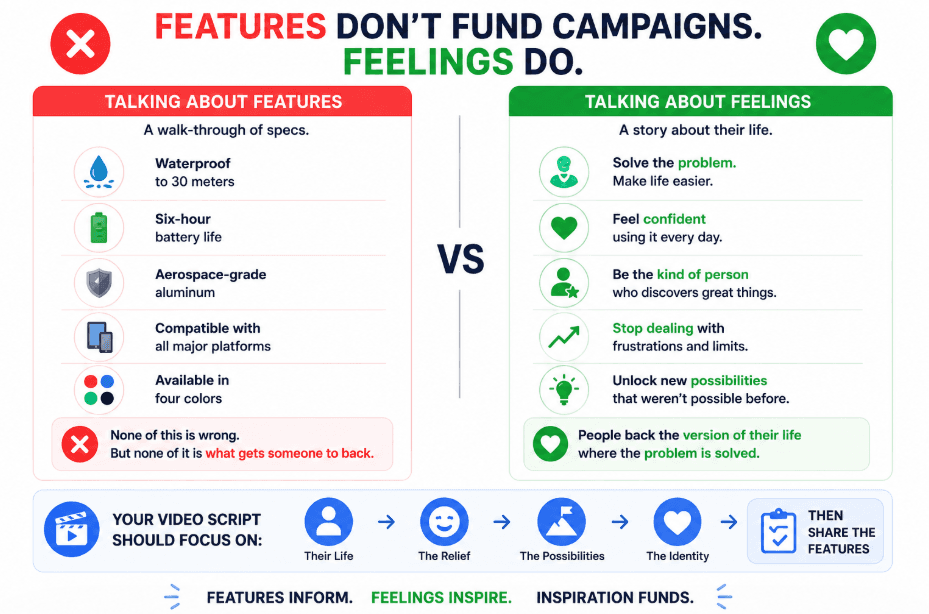
Creators love their product. They have spent months or years building it. They know every feature, every specification, every technical detail that makes it better than what came before. And so they make a video that is essentially a walking tour of those features.
Waterproof to 30 meters. Six-hour battery life. Aerospace-grade aluminum construction. Compatible with all major platforms. Available in four colors.
None of that is wrong. But none of it is what gets someone to back a campaign.
People do not back features. They back the version of their life where the problem is solved. They back the feeling of having something that works the way it should. They back the identity of being someone who finds and supports things worth supporting.
Your video script needs to spend far more time on what the product means for the person using it than on what the product technically does. What does life look like with this product? What does the backer get to stop dealing with? What becomes possible that was not possible before?
Features are fine to mention. But they should come after the emotional case has already been made, not instead of it.
The Video Is Too Long
The average crowdfunding video that underperforms is between three and five minutes long. The average crowdfunding video that converts well is under two and a half minutes. That is not a coincidence.
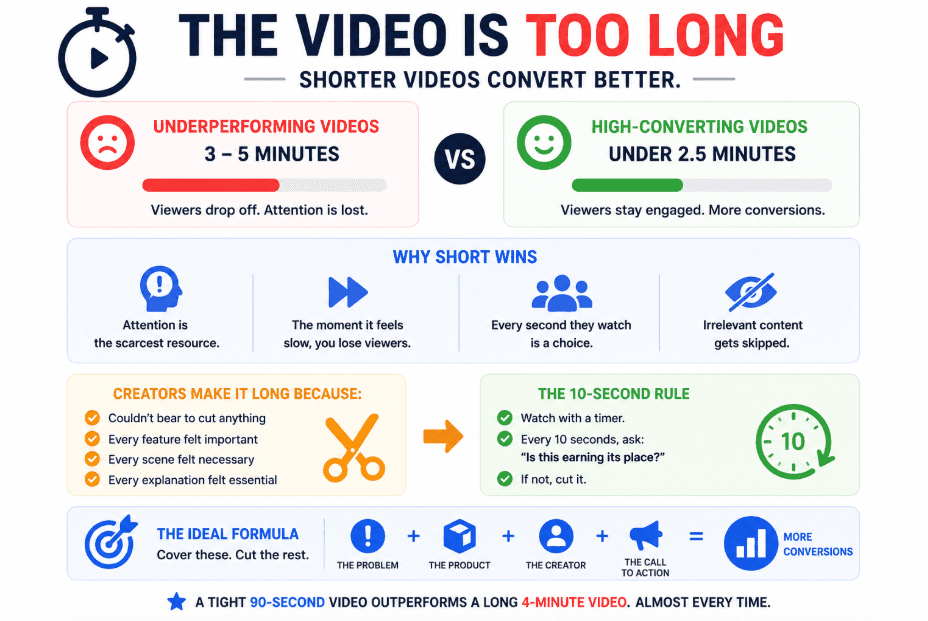
Attention is the scarcest resource on the internet. Every second you ask someone to give you is a second they could be doing something else. The moment your video stops earning that attention, which happens the moment something feels slow, repetitive, or tangential, you start losing viewers.
Most crowdfunding videos are long because the creator could not bear to cut anything. Every feature felt important. Every scene felt necessary. Every explanation felt like it would leave viewers confused if it were removed.
This is understandable and almost always wrong.
Watch your video with a timer and ask yourself honestly whether every ten-second segment is earning its place. Is it moving the story forward? Is it building trust or desire in a way that nothing else in the video is already covering? If the honest answer is no, cut it.
A tight 90-second video that covers the problem, the product, the creator, and the call to action with no wasted motion will outperform a thorough four-minute video almost every time. The viewer who finishes a short, compelling video and wants more is in a much better position to convert than the viewer who started a long video and gave up at the two-minute mark.
You Are Invisible in Your Own Video
Backers back people, not just products. This is one of the most consistently validated insights in crowdfunding, and most campaign videos completely ignore it.
If your entire video is product shots, animations, and lifestyle footage with a voiceover, you are missing one of the most powerful conversion tools available to you. The moment where the actual creator appears on camera, speaks directly to the viewer, and explains why they built this thing and why it matters to them personally is often the moment a potential backer goes from interested to convinced.
You do not need to be charismatic. You do not need to be polished. You need to be real.
A founder who is clearly a genuine human being, who has a real story behind the product they built, and who speaks about it with authentic enthusiasm, is more persuasive than the most beautifully produced product reel. Because it answers the question every backer is unconsciously asking: Is there a real person behind this who will actually deliver what they are promising?
Thirty seconds of genuine, direct-to-camera presence from you as the creator will do more for your conversion rate than thirty seconds of additional b-roll footage. Put yourself in the video.
The Production Quality Is Working Against You
There are two ways production quality kills crowdfunding videos. Most guides only talk about one of them.
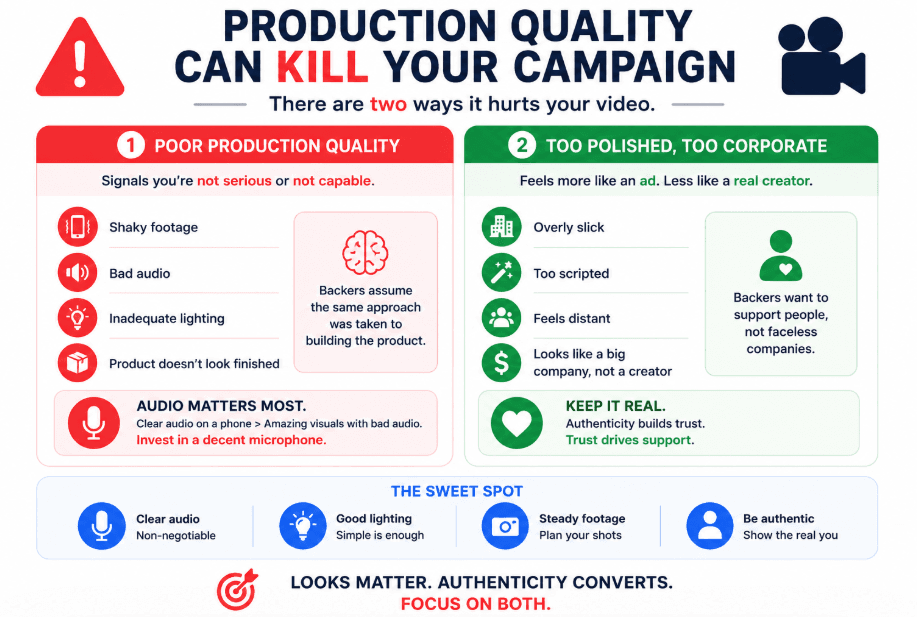
The obvious one is poor production quality. Shaky footage, bad audio, inadequate lighting, and a product that does not look finished are all signals to a potential backer that the creator is not serious or not capable. If your video looks like it was made in an afternoon with no planning, backers will assume the same approach was taken to building the product.
Audio matters more than almost anything else. A video shot on a phone in good light with clear, clean audio will outperform a beautifully shot video with muffled or echoey sound. If you invest in nothing else for your video production, invest in a decent microphone.
The less obvious production quality problem is a video that looks too polished and too corporate.
Crowdfunding backers are sophisticated. They have seen enough campaigns to know the difference between a genuine founder-led campaign and a product that has been professionally packaged to look like one. When a video feels like an ad rather than a campaign, when everything is too perfect and too produced, it can actually reduce trust rather than build it.
The sweet spot is competent and authentic. Good lighting, clean audio, steady footage, a product that looks real and finished. But with a human presence, natural moments, and a feeling that a real person made this rather than a marketing department.
Your Call to Action Is Weak or Missing
A significant number of crowdfunding videos end without telling the viewer what to do next.
The video finishes. Maybe there is a logo. Maybe there is a URL. And then it is over, and the viewer who was genuinely interested and ready to act is left to figure out the next step on their own.
This is a fixable problem that costs campaigns real money.
Your video needs to end with a direct, specific call to action. Not implied. Stated clearly. Tell the viewer to back the campaign. Tell them what they get when they do. Tell them where to find the reward tiers. If there is an early bird offer, mention it. Give them a reason to act now rather than closing the tab and coming back to it later, because most of the time, later never happens.
The call to action does not need to be long. Fifteen to twenty seconds at the end of the video is enough. But it needs to be there, it needs to be direct, and it needs to make the next step feel obvious and immediate.
You Have Not Shown the Product Working
This one sounds basic. It is surprisingly common.
Some crowdfunding videos, particularly for products that are still in prototype or early development, spend a lot of time talking about what the product will do and very little time showing it actually doing those things.
Renders and animations are fine as supporting material. They are not a substitute for footage of the actual product functioning the way the campaign promises it will function. Backers know the difference between a render and a working product. When a video relies heavily on renders and CGI rather than real product footage, it raises questions about whether the product actually works the way it is described.
If your product is not far enough along to film working convincingly, that is a signal to delay the campaign, not to find creative ways to work around it in your video. Backing a crowdfunding campaign already requires trust. Backing one where the product has never been shown actually working requires significantly more trust than most potential backers are willing to extend.
Show your product working. Show it working in the conditions your backers will actually use it in. Show it failing to work in the situations where the current alternative fails, and then show it succeeding where the alternative does not. That is the most persuasive footage you can put in a crowdfunding video.
You Did Not Test It Before You Launched
Most crowdfunding creators make their video, watch it themselves a few times, decide it is good, and launch.
The problem with this approach is that you are the worst possible judge of your own video. You know the product too well. You fill in gaps in the explanation automatically because you have context that your viewers do not have. You overlook things that feel slow or confusing because the content feels natural to you after months of working with it.
Before your video goes live on your campaign page, show it to people who know nothing about your product and watch their reactions in real time. Do not explain anything before they watch it. Just put it on and observe.
Where do they look confused? When do they seem to lose interest? What questions do they have after it ends that the video should have answered? What did they think the product was or did, and how close was that to what you intended?
The gap between what you think your video communicates and what someone watching it cold actually takes away from it is almost always larger than you expect. Finding that gap before you launch is how you fix it before it costs you, backers.
The Video Is a Conversion Tool, Not a Creative Project
The best crowdfunding videos feel creative. But the creativity is in service of conversion, not the other way around.
Every creative decision in your video, the opening, the pacing, the script, the on-camera presence, the call to action, should be evaluated against a single question: Does this make it more likely that someone watching will back the campaign?
If the answer is yes, keep it. If the answer is no, or even maybe, cut it or change it.
A video that wins a film festival award and generates five backers has failed. A video that looks slightly rough around the edges but clearly communicates the problem, the product, the creator, and the call to action, and generates two hundred backers has succeeded.
Make the video that converts. You can make the beautiful one after you have funded.
If you want someone to review your campaign video before it goes live and give you honest, specific feedback on what is working and what is not, SVBY has done this for campaigns that raised over $50,000 on Kickstarter. Book a free 30-minute call, and let's take a look at what you have.