How to Set a Crowdfunding Goal That Actually Makes Financial Sense
May 12, 2026

The funding goal is the number everyone sees the moment they land on your campaign page. It is the number that tells backers whether you are serious, whether the campaign is on track, and whether backing you is a safe bet.
It is also the number that quietly destroys more campaigns than almost any other single decision.
Set it too high, and you scare off early backers who do not want to pledge to a campaign that looks like it will never fund. Set it too low, and you hit your goal, celebrate, and then slowly realize the money you raised does not actually cover what it costs to deliver what you promised. Both outcomes happen constantly. Both are avoidable.
Setting a crowdfunding goal that makes financial sense is not complicated, but it requires you to do real math before you pick a number, not after. This guide walks through exactly how to do that.
Understand What Your Goal Actually Needs to Cover
The most common mistake creators make when setting their goal is thinking about it as a revenue target rather than a cost coverage number.
Your goal is not the amount of money you want to raise. It is the minimum amount you need to raise in order to actually deliver on every promise you make to every backer, pay every fee and cost along the way, and come out the other side without owing money on a campaign you technically won.
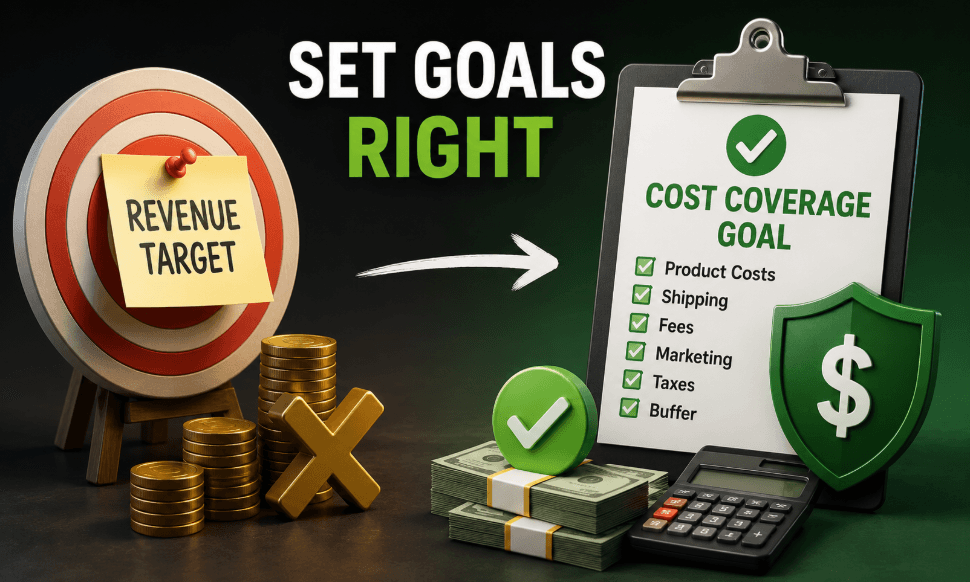
That reframe matters because it changes how you calculate the number. Instead of starting with what sounds impressive or what you hope to achieve, you start with what you actually need. And then you work backward from there.
Start With Your Unit Economics
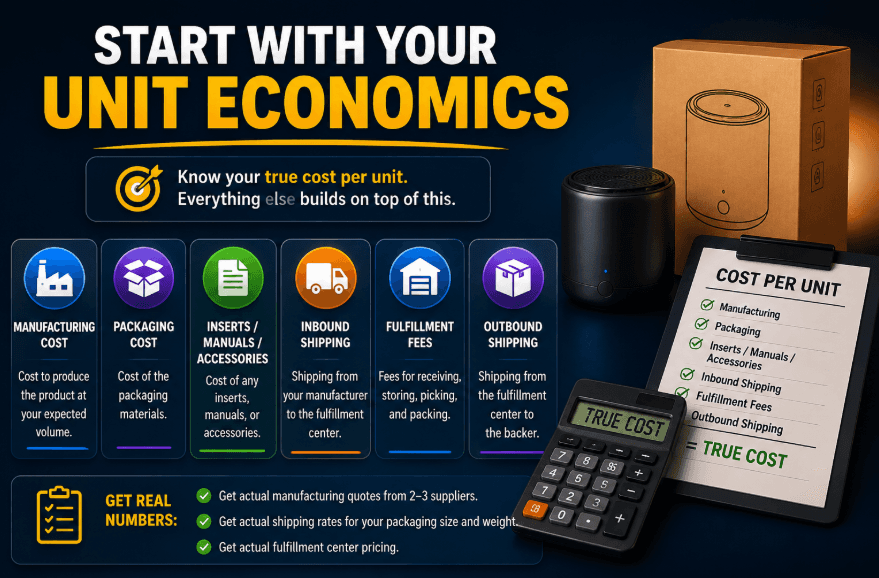
Before you can set a goal, you need to know what it actually costs you to produce and deliver one unit of your product to one backer.
This sounds simple. It almost never is.
Your cost per unit includes the manufacturing cost at your expected production volume, the cost of packaging, the cost of any inserts, manuals, or accessories included with the product, inbound shipping from your manufacturer to your fulfillment center, fulfillment center fees for receiving, storing, picking, and packing the product, and outbound shipping to the backer.
Each of those line items needs a real number, not an estimate pulled from thin air. Get actual manufacturing quotes from at least two or three suppliers. Get actual shipping rates for the packaging dimensions and the weight your product will ship at. Get actual fulfillment center pricing if you are using one.
The number you end up with is your true cost per unit. Everything else in your goal calculation builds on top of this.
Account for Platform and Payment Processing Fees
This step is straightforward but consistently forgotten in first-time goal calculations.
Kickstarter takes 5 percent of everything you raise. Payment processing adds another 3 to 5 percent on top of that. Combined, you are losing 8 to 10 percent of every pledge before you have spent a single dollar on production or fulfillment.
On a $50,000 campaign, that is $4,000 to $5,000 gone immediately. On a $100,000 campaign, it is $8,000 to $10,000.
Build this into your goal from the start. If you need $50,000 to cover your costs after fees, your goal needs to be higher than $50,000 to actually net you $50,000.
The math works like this. Divide the amount you need to net by 0.91 if you are assuming 9 percent in combined fees. That gives you the gross amount you need to raise to end up with what you actually need after fees come out.
Factor In Your Marketing and Campaign Costs
The money you spend to run the campaign does not come from somewhere outside the campaign. It comes from the money you raise.
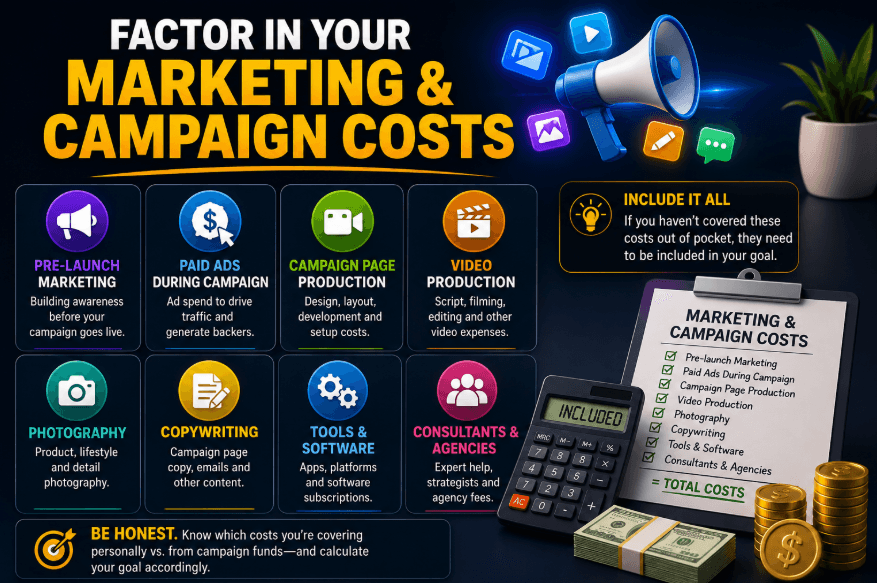
Pre-launch marketing, paid ads during the campaign, campaign page production, video production, photography, copywriting, any tools or software you used, any consultants or agencies you hired. All of it needs to be factored into your goal calculation if you have not already covered those costs out of pocket before the campaign launched.
Some creators fund their pre-launch costs personally and treat them as sunk costs before the campaign goes live. That is a legitimate approach, and it simplifies the goal calculation. Others plan to cover some or all of their marketing costs from campaign funds, which means those costs need to be baked into the goal.
Be honest about which category you are in and calculate accordingly.
Know Your Minimum Order Quantity
If you are producing a physical product, your manufacturer almost certainly has a minimum order quantity. This is the smallest number of units they will produce in a single run, and it has a direct impact on your goal calculation.
Here is why it matters. Your goal needs to be set at a level that will fund enough backers to justify your minimum production run. If your manufacturer requires a minimum of 500 units and your average reward tier is $80, you need at least $40,000 in pledges before your production run even makes sense financially. Your goal cannot be set below that number, regardless of what your other costs look like.
At the same time, your unit cost at minimum order quantity is almost always higher than your unit cost at larger volumes. The manufacturer's price per unit goes down as order volume goes up. When you are calculating your cost per unit for goal-setting purposes, use the cost at your minimum order quantity, not the cost at the optimistic volume you hope to hit if the campaign goes well.
This is conservative and intentional. You are setting a goal based on the minimum scenario, not the best case. If the campaign exceeds your goal and you end up producing more units at a lower cost per unit, that is a good problem to have.
Build In a Contingency Buffer
Real campaigns rarely go exactly as planned. Manufacturing costs change. Shipping rates increase. A component you specified at a certain price becomes unavailable, and the alternative costs more. Customs fees in a particular country are higher than your spreadsheet assumed. Packaging needs to be redesigned after the first prototype, as it does not protect the product adequately.
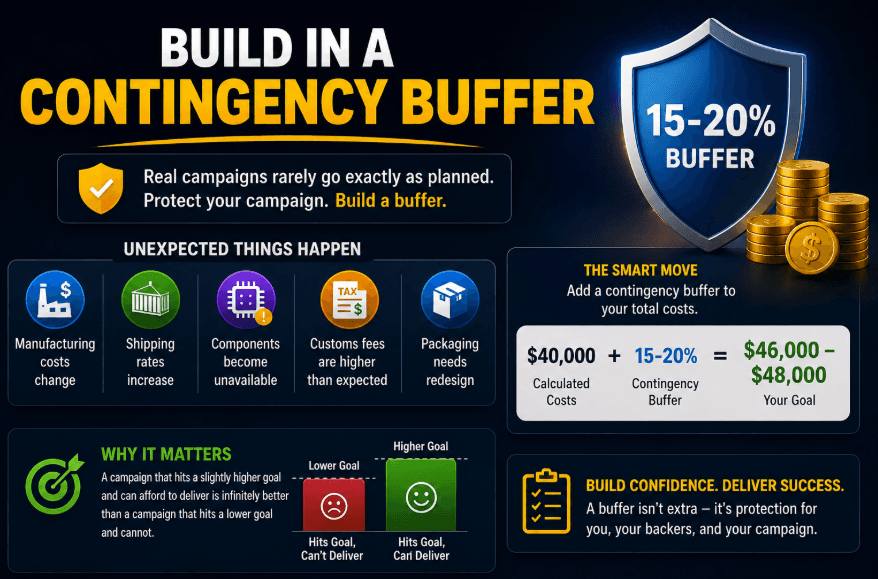
Every one of these things happens to real campaigns. The creators who survive them are the ones who built a financial buffer into their goal. The ones who did not end up funding campaigns they cannot afford to fulfill.
A standard contingency buffer for a first-time crowdfunding campaign is 15 to 20 percent on top of your calculated costs. That means if your honest cost calculation comes out to $40,000, your goal should be set at $46,000 to $48,000 to give yourself room to absorb the unexpected costs that will come.
This feels uncomfortable to some creators because a higher goal feels harder to hit. But a campaign that hits a slightly higher goal and can afford to deliver is infinitely better than a campaign that hits a lower goal and cannot.
Do Not Set Your Goal Based on What You Think You Can Raise
This is the mistake that causes more financial pain than any other single error in crowdfunding.
A creator looks at their email list, their social following, and their enthusiasm, and they pick a number that feels achievable based on how much momentum they think they can generate. They set the goal at $25,000 because it sounds realistic, not because $25,000 is what they actually need to fulfill the campaign.
Then they hit $25,000, celebrate, and start crunching the real numbers. By the time they finish calculating actual manufacturing costs, actual shipping, actual fees, and actual fulfillment, they realize that $25,000 covers about 60 percent of what they owe their backers.
The goal should be set based on your costs, not on your confidence about what you can raise. If the number your costs require seems too high to hit with the audience you have built, that is important information. It means either your audience is not large enough yet, your costs are higher than the market will bear, or your reward tier pricing needs to be reconsidered.
None of those are reasons to set a lower goal and hope the math works out. There are reasons to address the underlying problem before you launch.
Your Reward Tier Pricing and Your Goal Have to Be Consistent
Here is a calculation that many first-time creators forget to run.
Take your funding goal and divide it by the price of your main reward tier. That gives you the number of backers you need at that tier to fund your campaign.
Now ask yourself honestly whether the audience you have built is large enough to produce that many backers. A general benchmark is that somewhere between 1 and 5 percent of your email list will back your campaign, with the exact conversion rate depending on how warm your list is, how compelling your page is, and how well your launch goes.
If your goal requires 500 backers at your main tier and your email list has 400 subscribers, the math does not work. Not because 500 backers is impossible, but because you cannot get there from where you are starting.
Running this calculation before you set your goal tells you whether your audience size and your goal are aligned. If they are not, you either need to keep building your audience before you launch or reconsider the goal and pricing structure until the numbers make sense together.
Should You Set a Stretch Goal?
Stretch goals are targets above your main funding goal that unlock additional rewards, features, or improvements for all backers. They are a legitimate tool for adding momentum to a campaign that has already been funded and keeping existing backers engaged and sharing.
But stretch goals carry their own financial risks that are worth understanding before you set them.
Every stretch goal you hit increases your fulfillment commitments. If your stretch goal at $75,000 unlocks a premium carrying case for all backers and you end up raising $90,000, you now owe a carrying case to every single backer, including the ones who backed at your lowest tier. That additional cost needs to be accounted for in how you price the stretch goal relative to the reward it unlocks.
Set stretch goals at levels where the incremental revenue they unlock covers the incremental cost of the additional reward with enough margin remaining to make it financially worthwhile. Do not set stretch goals just to have something to announce. Set them because you have done the math, and they make sense.
What a Goal Calculation Actually Looks Like
Here is a simplified example of how this works in practice.
Imagine you are launching a physical product with a manufacturing cost of $18 per unit at your minimum order quantity of 300 units. Packaging costs $2 per unit. Domestic shipping costs $6 per unit on average, with international shipping at $14. Fulfillment center fees add $3 per unit.
Your cost per unit for domestic backers is $29. For international backers, it is $37. If you estimate that 70 percent of your backers will be domestic and 30 percent international, your blended cost per unit is roughly $31.40.
You are planning to sell your main reward tier at $79. After platform and payment fees of roughly 9 percent, you net approximately $71.90 per pledge. Subtract your blended fulfillment cost of $31.40, and you are left with about $40.50 per backer to cover everything else.
You spent $8,000 on pre-launch marketing and campaign production that you need to recover. Your contingency buffer at 15 percent adds another cushion on top. Running these numbers gives you a minimum backer count and a minimum funding goal that actually holds up financially.
This is simplified. Your real calculation will have more variables. But the process is the same. Start with real costs, work forward to what you need, and set your goal based on the answer rather than the number that sounds most achievable.
The Goal Is a Promise
When you set a funding goal and a backer pledges to help you hit it, they are trusting that you have done the math and that the goal represents a real and honest assessment of what you need to deliver.
Setting a goal that cannot cover your costs is not just a financial mistake. It is a breach of that trust. Backers who funded a campaign that cannot afford to ship their rewards are not just disappointed. They feel deceived, and rightfully so.
Do the math properly. Set the goal honestly. Build in the buffer. Launch with a number that you can actually stand behind.
If you want help running the numbers on your campaign before you commit to a goal, SVBY has worked through this with creators who went on to raise over $50,000 on Kickstarter. Book a free 30-minute call, and let's make sure your goal is set up to actually work.