From Idea to Funded: A Complete Crowdfunding Timeline for First-Time Launchers
May 7, 2026
Most first-time crowdfunding creators underestimate how long the process actually takes.
They have an idea in January, decide they want to launch in February, and wonder why everything feels rushed and underprepared when the campaign goes live. The campaigns that fund reliably are almost never the ones that launched quickly. They are the ones where the creator gave themselves enough time to do each phase properly before moving to the next.
This guide lays out a realistic timeline from the moment you have an idea worth launching to the moment your campaign hits its funding goal. Not an optimistic timeline. A realistic one, built around what actually works.
The Full Picture Before You Start
A well-run crowdfunding campaign from idea to funding typically takes five to eight months. That number surprises most people. It should not.
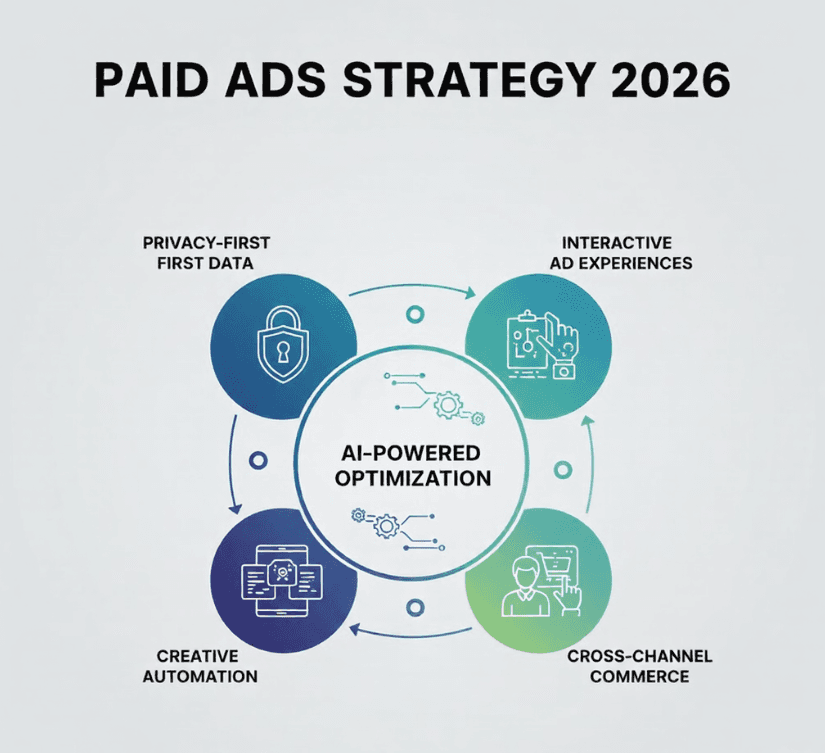
Think about what has to happen before you can even go live. You need a product that is far enough along to be photographed and filmed convincingly. You need a campaign page that converts. You need a pre-launch audience large enough to give you a strong first 48 hours. You need a paid ads strategy that has been tested before launch day. You need a fulfillment plan that actually holds up financially.
None of those things happens in a few weeks. Each one requires dedicated time and attention. Trying to compress the timeline by skipping phases or rushing through them is the fastest way to end up with a campaign that underperforms despite having a genuinely good product.
Give yourself the time. The campaigns that look effortless from the outside almost always had five or six months of invisible preparation behind them.
Month One: Validate Before You Build
The first thing to do when you have a crowdfunding idea is not to start building. It is to find out whether anyone other than you wants it.
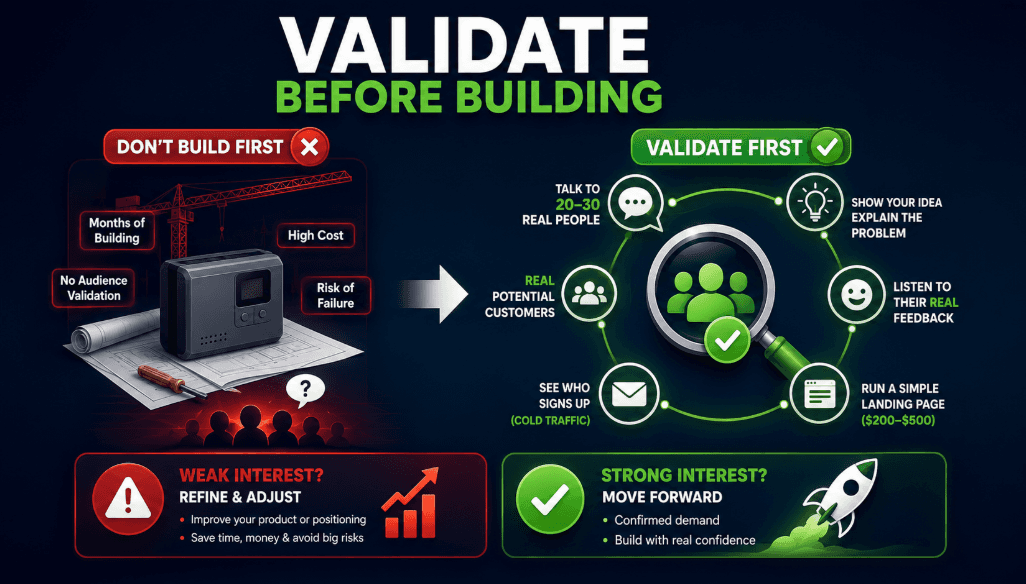
Validation is the step most creators skip because it feels like a delay. It is actually the most important thing you can do in the entire process, because it tells you whether the campaign you are about to spend months preparing for has a real audience waiting for it.
Validation does not need to be complicated. Talk to twenty to thirty people who match your target backer profile. Not friends and family who will tell you it is a great idea regardless. Real potential customers. Show them what you are building, explain the problem it solves, and pay close attention to how they respond. Are they excited? Do they ask how soon they can get one? Do they volunteer to pay for it? Or are they politely interested in the way people are politely interested in things they would never actually buy?
Run a small pre-launch landing page with a basic ad budget, somewhere between two hundred and five hundred dollars, and see whether people sign up. Not your friends. Cold traffic from people who match your target audience. If you cannot get cold strangers to give you their email address in exchange for early access at a discount, that is important information to have before you have spent six months and several thousand dollars preparing a full campaign.
If validation tells you that interest is weak or the target audience is not who you thought it was, use that information to refine the product or the positioning before going further. A month spent validating and adjusting now is worth more than four months spent preparing a campaign that nobody backs.
If validation confirms genuine demand, you have your green light. Move forward with real confidence.
Month Two: Get the Product Campaign-Ready
Your product does not need to be in final production form to run a crowdfunding campaign. But it needs to be far enough along that you can show it working, photograph it convincingly, and talk about it with enough specificity that backers trust you can actually deliver.
For most physical products, this means having a functional prototype that looks and performs close to how the final product will look and perform. Not a rough proof of concept held together with tape and optimism. Something that a production team can photograph and a potential backer can watch in a video and feel confident about.
Getting to that point often takes longer than expected. Manufacturing quotes come back late. Materials are harder to source than you planned. The first prototype reveals problems that need to be solved before you can move forward. Build buffer time into this phase because almost everyone needs it.
While the product is being refined, start getting clear on your production and fulfillment plan. How will the product be manufactured at scale? What is your minimum order quantity? What are your unit costs at different order volumes? What does shipping look like for domestic and international backers?
These are not questions to figure out after the campaign funds. These are questions that need answers before you can set a funding goal that actually covers your costs.
Month Three: Build Your Campaign Assets
With a campaign-ready product in hand, month three is where you create everything that will live on your campaign page.
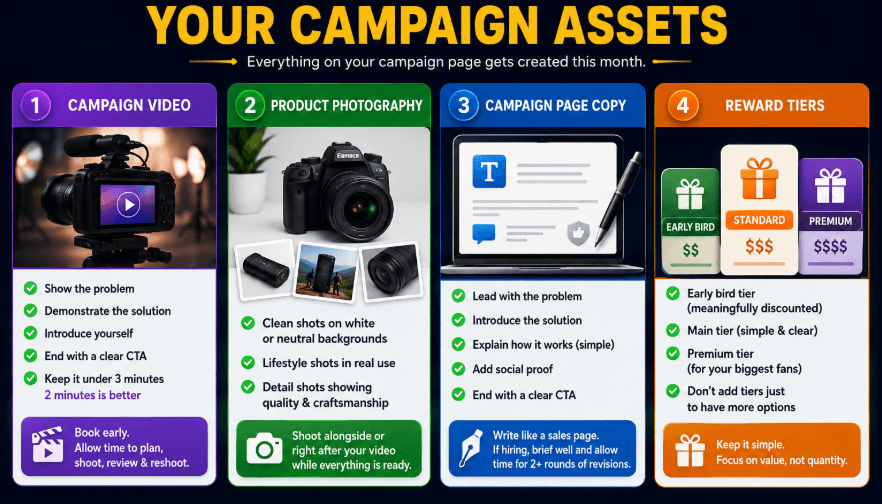
Your video comes first because it is the most important asset and the one that takes the longest to get right. Book your production team early. If you are producing it yourself, plan your shoot dates, write your script, and leave time to review and reshoot anything that does not work on the first pass.
A strong campaign video shows the problem your product solves, demonstrates the product actually working, introduces you as the creator in a way that builds trust, and ends with a clear call to action. Keep it under three minutes. Two is better.
Product photography happens alongside or immediately after the video shoot while your product is looking its best and your production team is already assembled. You need clean product shots on white or neutral backgrounds, lifestyle shots showing the product being used in real contexts, and detail shots that show quality and craftsmanship.
Your campaign page copy gets written during this month as well. If you are writing it yourself, treat it like the sales page it is. Lead with the problem, introduce the product as the solution, explain how it works without drowning people in specs, include your social proof, and end with a clear call to action. If you are hiring a copywriter, brief them thoroughly and give them time to go through at least two rounds of revisions.
Your reward tier structure gets finalized this month, too. Price your early bird tier meaningfully below your main tier. Keep your main tier simple and clearly described. Add a premium tier for your most enthusiastic backers. Do not add tiers just to have more options.
Month Four: Build Your Pre-Launch Audience
Month four is the one that has the biggest impact on your launch day results, and the one that most creators either rush through or start too late.
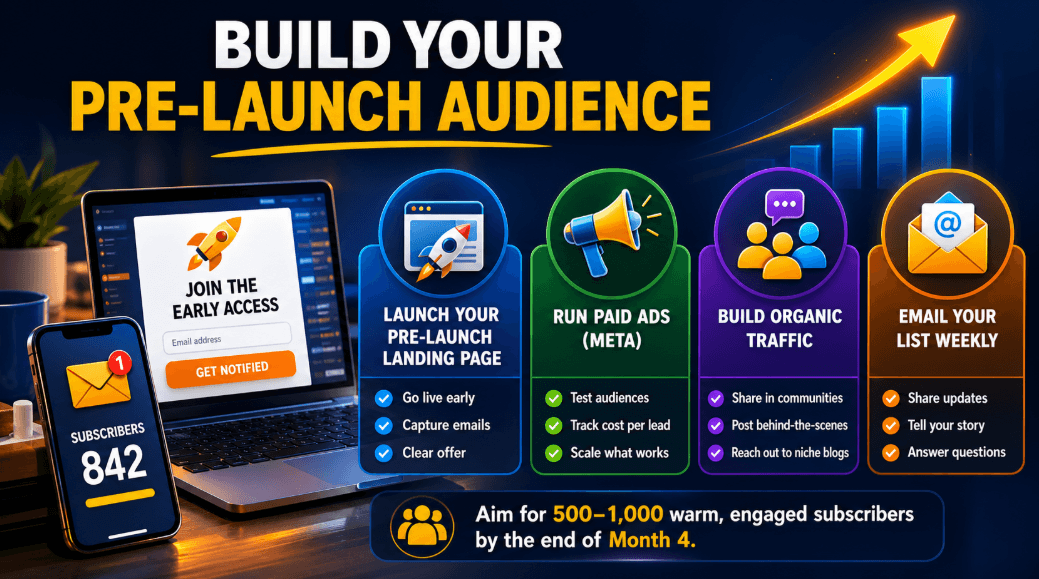
Your goal this month is to build an email list of people who are genuinely interested in your product, warm them up with regular communication, and arrive at launch day with a group of subscribers who are ready to back you within the first 24 hours.
Start by getting your pre-launch landing page live as early in this month as possible. Every week you delay is a week of potential subscribers you are not collecting.
Run paid ads to drive traffic to the landing page. Meta ads are the most commonly used channel for this. Start with a small daily budget and test multiple audiences and creatives simultaneously. Look at your cost per lead and your lead quality, not just your click-through rate. Scale the audiences and creatives that perform and cut the ones that do not.
Build organic traffic in parallel. Share your product in relevant communities, post behind-the-scenes content on social media, reach out to niche newsletters and blogs that cover your product's category, and be genuinely present in the spaces where your target backers spend time.
Email your list regularly throughout this month. Not every day. Once or twice a week is plenty. Share product updates, behind-the-scenes content, the story of why you are building this, and answers to questions you have been getting from interested people. The goal is that by the time you launch, your subscribers feel like they know you and are personally invested in seeing you succeed.
By the end of month four, aim to have at least five hundred to a thousand subscribers on your list. More is better, but five hundred warm, engaged subscribers who have been hearing from you consistently will outperform five thousand cold leads who signed up once and never heard from you again.
Month Five: Prepare Everything for Launch
Month five is the preparation month. By the time launch day arrives, every single thing that needs to be ready should already be ready.
Your campaign page should be fully built and reviewed by people who are not involved in the project. Fresh eyes catch things that you, having stared at the page for weeks, have completely stopped seeing. Find people who match your target backer profile and watch them read the page. Note where they get confused, where they lose interest, and what questions they still have at the end. Use that feedback to make your final revisions.
Your paid ads should be fully built in your ad manager, with creatives approved, audiences defined, and budgets set. Your retargeting audiences should be built from everyone who has visited your landing page during the pre-launch period. Your launch day ads should be ready to turn on the moment the campaign goes live.
Your email sequences should be written and scheduled. Your launch day email, your day two follow-up, your first week campaign update, and your mid-campaign email should all be drafted and ready to send. Do not write these on the day you need them.
Do your personal outreach this month. Reach out directly to friends, colleagues, community members, and anyone in your network who would genuinely want to back the campaign. Let them know it is coming, tell them what you are building, and ask them specifically to back you on day one. Personal outreach converts at a dramatically higher rate than mass emails.
Set up your Kickstarter or Indiegogo account and submit your campaign for review early. Both platforms review campaigns before they go live, and the review process can take several days. Submit at least a week before your planned launch date so you have time to address any issues without delaying your launch.
Launch Week: Execute the Plan
Launch week is not the time to be creative or to improvise. It is time to execute the plan you have already built.
Launch on a Tuesday, Wednesday, or Thursday morning in your target market's time zone. Avoid Mondays when people are catching up on the week. Avoid Fridays when people are mentally checking out. Mid-week mornings give you the most active potential backers at the moment your campaign goes live.
Send your launch email the moment your campaign is live. Not ten minutes later. Not after you have refreshed the page to make sure everything looks right. Immediately.
Turn your ads on at the same moment. Every hour of delay on the first day is a pledge you are not capturing.
Post across every social channel you have been active on. Keep it direct and simple. The campaign is live. Here is what it is. Here is the link.
Respond to every comment, every message, and every email within hours if possible. Your presence and responsiveness on launch day are themselves a signal to potential backers that the creator is real, engaged, and trustworthy.
Stay close to your metrics throughout the day. Watch your traffic, your conversion rate, your ad performance, and your pledge total. If something is significantly off from your expectations, catch it early while you still have the full day to adjust.
The Campaign Period: Weeks Two Through Four
Your campaign is live. Now the job is to sustain momentum for however long your campaign runs, which is typically 30 days for a first campaign.
Week two is where most campaigns start to feel the mid-campaign slowdown. Your warmest audience has already converted. Your ads are reaching colder traffic. The excitement of the launch has faded. This is normal, and you planned for it.
Keep your ad creative fresh. Refresh your targeting. Send your mid-campaign email to the non-backers on your list. Launch your stretch goal if you have one ready. Do community outreach to places you have not reached yet. Follow up on any press outreach that did not get a response the first time.
Post regular backer updates throughout the campaign, at a minimum once a week. Tell your backers what is happening, what you have learned, and what comes next. Give them something worth sharing. Backers who feel included and appreciated become advocates who bring you new backers.
In the final week, your urgency-based messaging kicks in. The campaign is ending. After this, the early bird pricing is gone, and the product will not be available for pre-order for months. Let your retargeting audiences know that time is running out. Send a final email to your non-backer subscribers. Scale up your ad spend if your budget allows. The final 48 hours of a well-run campaign almost always produce a meaningful spike in pledges.
After the Campaign: Delivering on Your Promises
Funding your campaign is not the finish line. It is the starting line for the harder work of actually delivering what you promised.
The first thing to do after your campaign closes is to communicate clearly with your backers about what happens next. When will they receive updates? What is the production timeline? What are the key milestones between now and delivery?
Set expectations honestly. If you think the product will ship in eight months, do not promise six months and miss it. Backers who receive a product later than promised but who were kept informed throughout the process are generally forgiving. Backers who feel like they were misled about timelines and kept in the dark lose trust in you permanently.
Update your backers regularly throughout the production and fulfillment process. Monthly updates are a reasonable minimum. Share real progress, real photos, and real information. When problems arise, which they will, communicate about them proactively rather than going quiet and hoping backers do not notice.
The creators who build lasting businesses from their crowdfunding campaigns are almost always the ones who treated their backers well throughout the entire process, from the first email they ever sent to the moment the product landed on every backer's doorstep.
Your Timeline at a Glance
Month one is for validation. Confirm that real people want what you are building before you invest serious time and money in building it.
Month two is for getting the product campaign-ready. A functional, photographable prototype and a clear production and fulfillment plan.
Month three is for building your campaign assets. Video, photography, page copy, and reward tier structure.
Month four is for building your pre-launch audience. Landing page, paid ads, organic outreach, and regular email communication.
Month five is for preparing everything needed for launch. Final page review, ads ready to go, email sequences written, personal outreach done.
Launch week is for executing the plan you built. Email, ads, social, personal outreach, and staying close to your metrics.
Weeks two through four are for sustaining momentum. Fresh creative, mid-campaign email, stretch goals, press and community outreach, regular backer updates, and a strong final push.
After the campaign is for delivering on your promises. Clear communication, regular updates, and treating your backers the way you would want to be treated.
The Timeline Is the Strategy
The creators who follow a timeline like this are not the ones who got lucky. They are the ones who gave themselves enough time to do each phase properly, made decisions based on real data rather than optimism, and treated every part of the process with the seriousness it deserves.
Crowdfunding rewards preparation more than almost anything else. The campaign you see on screen for 30 days is the visible tip of months of invisible work. If that works properly, and the 30 days take care of themselves.
If you want help building a campaign timeline that is specific to your product, your audience, and your launch goals, SVBY has guided creators through this entire process and helped them raise over $50,000 on Kickstarter. Book a free 30-minute call, and let's map out exactly what your campaign needs and when it needs to happen.